Master Poverty, Unemployment, Development for SSC CGL
Get comprehensive theory, expert shortcuts, and hand-picked practice questions for Poverty, Unemployment, Development specifically designed for the SSC CGL 2025-26 pattern.
Poverty, Unemployment & Social Development in India
Issues of social development, poverty estimation methods, types of unemployment, and government welfare schemes form a key part of the Economics section in SSC CGL. Candidates must master the metrics used by the Tendulkar and Rangarajan committees, differentiate between structural, disguised, and seasonal unemployment, and understand the core features of flagship development initiatives. This module covers these areas comprehensively, ending with 20 premium solved CGL-pattern questions.
Learning path
- Poverty Concepts & Committee Estimates
- Types of Unemployment & Measurement
- Flagship Central Welfare Schemes
- 20 CGL-Pattern Practice MCQs
1. Poverty in India: Concepts & Estimation
Poverty is a state in which a person or community lacks the financial resources and essentials for a minimum standard of living. Economists categorize poverty into two types:
- Absolute Poverty: A condition where household income is below a necessary level to maintain basic living standards (food, shelter, housing). It is measured against a fixed poverty line.
- Relative Poverty: A condition where people lack the minimum amount of income needed in order to maintain the average standard of living in the society they live in. It is a measure of income inequality, usually represented via the Gini Coefficient and the Lorenz Curve.
Key Poverty Estimation Committees
Poverty estimation in India is officially conducted by the NITI Aayog (formerly Planning Commission) using data compiled by the National Statistical Office (NSO). Historically, several committees have defined the criteria:
| Committee & Year | Estimation Basis / Criterion | Key Recommendation / Outcome |
|---|---|---|
| Y.K. Alagh Committee (1979) | Calorie intake requirement | Set minimum calorie requirements: 2400 kcal per day for rural areas and 2100 kcal per day for urban areas. |
| D.T. Lakdawala Committee (1993) | Calorie-basis linked to CPI-AL and CPI-IW | Recommended state-specific poverty lines updated using Consumer Price Index for Agricultural Labourers (CPI-AL) and Consumer Price Index for Industrial Workers (CPI-IW). |
| Suresh Tendulkar Committee (2009) | Shift from calorie intake to consumption basket (MPCE) | Incorporated spending on education and health. Defined poverty line as Rs. 27 per day in rural areas and Rs. 33 per day in urban areas (corresponding to 21.9% poverty rate nationally in 2011-12). |
| C. Rangarajan Committee (2014) | Modified consumption basket (food + non-food) | Re-calculated poverty line using a wider basket including protein/fat requirements, house rent, and clothing. Set at Rs. 32 per day for rural and Rs. 47 per day for urban areas (corresponding to 29.5% poverty rate in 2011-12). |
2. Unemployment: Types & Measurement
Unemployment occurs when a person who is actively searching for employment is unable to find work. It is a critical indicator of economic health. The different forms of unemployment are mapped below:
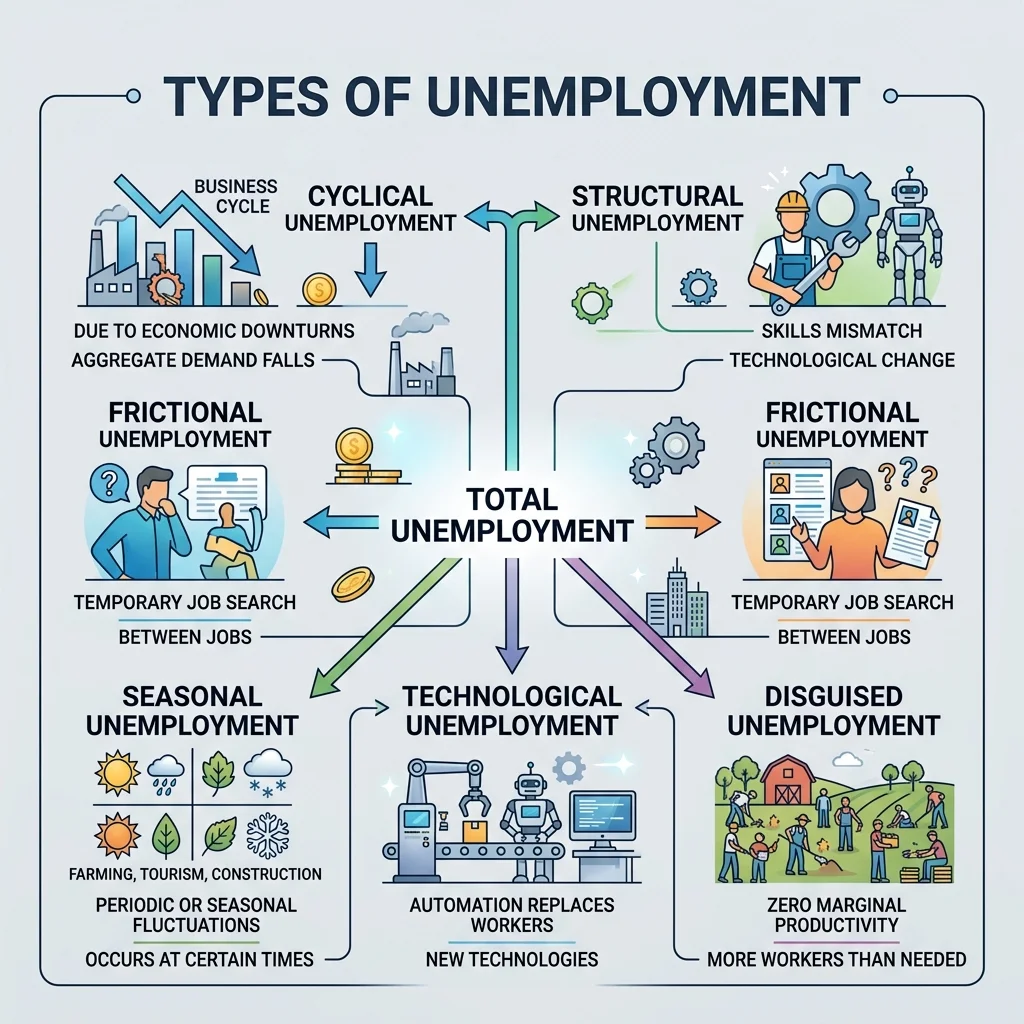
Key Types of Unemployment
- Disguised Unemployment: A phenomenon where more people are employed than actually needed. The marginal productivity of extra labor is zero. It is highly prevalent in India's agricultural sector.
- Structural Unemployment: Arises from a mismatch between the jobs available in the market and the skills of the available workers. Often caused by technological advancements or systemic shifts in the economy.
- Seasonal Unemployment: Occurs when people are unemployed during certain seasons of the year when demand for labor is low (e.g., agricultural laborers between sowing and harvesting seasons, agro-processing factory workers).
- Frictional Unemployment: Also known as search unemployment, it is the time period between when a worker leaves one job and finds another. It is voluntary and temporary.
- Cyclical Unemployment: Results from business cycle fluctuations. It rises during recessions and falls during economic expansions. (Common in developed economies, less typical for India's structural issues).
- Technological Unemployment: Loss of jobs caused by technological changes (e.g., automation, introduction of AI).
Unemployment Measurement Metrics
The NSO uses three reference periods to estimate unemployment in its Periodic Labour Force Survey (PLFS):
- Usual Status (US): Reference period is 365 days preceding the date of survey. Measures chronic/long-term unemployment.
- Current Weekly Status (CWS): Reference period is 7 days preceding the date of survey. A person is considered employed if they worked for at least 1 hour on any day during the reference week.
- Current Daily Status (CDS): Reference period is each day of the 7 days preceding the survey. Most granular indicator, capturing underemployment.
3. Major Development & Welfare Schemes
To alleviate poverty, build infrastructure, and generate employment, the Government of India operates several flagship schemes frequently tested in the SSC CGL exam:
- MGNREGA (Mahatma Gandhi National Rural Employment Guarantee Act, 2005): Guarantees at least 100 days of demand-driven wage employment in a financial year to every rural household whose adult members volunteer to do unskilled manual work. One-third of proposed jobs are reserved for women.
- Pradhan Mantri Jan Dhan Yojana (PMJDY - 2014): A financial inclusion campaign providing bank accounts, overdraft facilities (up to Rs. 10,000), and Rupay debit cards with built-in accident insurance.
- Pradhan Mantri MUDRA Yojana (PMMY - 2015): Provides collateral-free refinancing loans up to Rs. 10 lakh to micro-business units. Loans are categorized into three stages:
- Shishu: Loans up to Rs. 50,000.
- Kishor: Loans from Rs. 50,001 to Rs. 5 Lakh.
- Tarun: Loans from Rs. 5,00,001 to Rs. 10 Lakh.
- Pradhan Mantri Kisan Samman Nidhi (PM-KISAN - 2019): Direct benefit transfer providing an income support of Rs. 6,000 per year in three equal installments of Rs. 2,000 directly into the bank accounts of all landholding farmer families.
- Atal Pension Yojana (APY - 2015): Pension scheme targeted at unorganized sector workers, offering guaranteed pension of Rs. 1,000 to Rs. 5,000 per month starting at age 60, based on contributions.
4. Practice Questions (20 Premium Solved Questions)
Which of the following committees first recommended setting separate poverty lines for rural and urban areas in India based on daily calorie intakes of 2400 kcal and 2100 kcal, respectively?
Step-by-step Solution
What type of unemployment is characterized by the marginal productivity of labor being equal to zero?
Step-by-step Solution
In which year did the Suresh Tendulkar Committee submit its report on the methodology for poverty estimation in India?
Step-by-step Solution
Under the Pradhan Mantri MUDRA Yojana, what is the maximum loan limit allowed under the 'Tarun' category?
Step-by-step Solution
Under the provisions of the MGNREGA Act 2005, what percentage of the proposed jobs must be reserved for female beneficiaries?
Step-by-step Solution
Which committee, formed in 2012, revised the Tendulkar poverty line upwards to Rs. 32 per day for rural and Rs. 47 per day for urban areas?
Step-by-step Solution
Which index or curve is used by economists to graphically represent income inequality in a society?
Step-by-step Solution
What type of unemployment occurs when a worker is temporarily out of work because they are voluntarily transitioning from one job to another?
Step-by-step Solution
Which of the following bodies is responsible for collecting the raw national-level sample survey data used for estimating poverty in India?
Step-by-step Solution
The Pradhan Mantri Kisan Samman Nidhi (PM-KISAN) scheme provides financial support to farming families. What is the total annual cash transfer amount?
Step-by-step Solution
What type of unemployment is caused by technological advancements making the skills of certain workers obsolete?
Step-by-step Solution
Which poverty measurement index captures not only the headcount of the poor but also how far the poor are, on average, below the poverty line?
Step-by-step Solution
What is the maximum overdraft limit available to eligible account holders under the Pradhan Mantri Jan Dhan Yojana (PMJDY)?
Step-by-step Solution
In the estimation of employment-unemployment by the NSO, which status is determined on the basis of a reference period of one week?
Step-by-step Solution
A farmer is out of work for five months a year between the sowing and harvesting seasons. What category of unemployment does this fall under?
Step-by-step Solution
The Gini Coefficient, which represents income inequality, ranges between which of the following values?
Step-by-step Solution
In which year was the Mahatma Gandhi National Rural Employment Guarantee Act (MGNREGA) passed by the Parliament?
Step-by-step Solution
Under the Atal Pension Yojana (APY), what is the minimum and maximum age limit for subscriber entry?
Step-by-step Solution
Which of the following metrics is used in the Tendulkar Committee methodology to determine poverty, departing from the previous calorie-based approach?
Step-by-step Solution
Which of the following types of unemployment is most common during macroeconomic recessions or economic downturns in developed markets?
Step-by-step Solution
Strategy errors to avoid
Disguised vs. Seasonal
Disguised unemployment is when excess labor is employed and marginal productivity is zero. Seasonal unemployment is when workers are idle between agricultural periods. Do not confuse the two when questions reference rural India.
Tendulkar vs. Rangarajan Daily Spending
Tendulkar proposed Rs. 27 (rural) and Rs. 33 (urban) daily poverty thresholds. Rangarajan revised these upwards to Rs. 32 (rural) and Rs. 47 (urban). Ensure you check which committee the question references.