Master Indian Economy (Five Year Plans, Budget) for SSC CGL
Get comprehensive theory, expert shortcuts, and hand-picked practice questions for Indian Economy (Five Year Plans, Budget) specifically designed for the SSC CGL 2025-26 pattern.
Indian Economy: Five-Year Plans, NITI Aayog & Union Budget
Economic planning and fiscal policy are fundamental to the SSC CGL general awareness syllabus. Candidates must master the models and milestones of the 12 Five-Year Plans, the transition to NITI Aayog, and the classification of the Union Budget alongside key deficit metrics (Fiscal, Revenue, and Primary Deficits). This guide synthesizes these core topics with 20 solved practice questions.
Learning path
- Five-Year Plans & Models
- NITI Aayog vs. Planning Commission
- Union Budget, Revenue/Capital & Deficits
- 20 CGL-Pattern Solved Questions
1. Economic Planning & Five-Year Plans
Economic planning in India began in 1950 with the setting up of the Planning Commission, inspired by the Soviet Union's state-planning model. India executed 12 Five-Year Plans before the system was restructured.
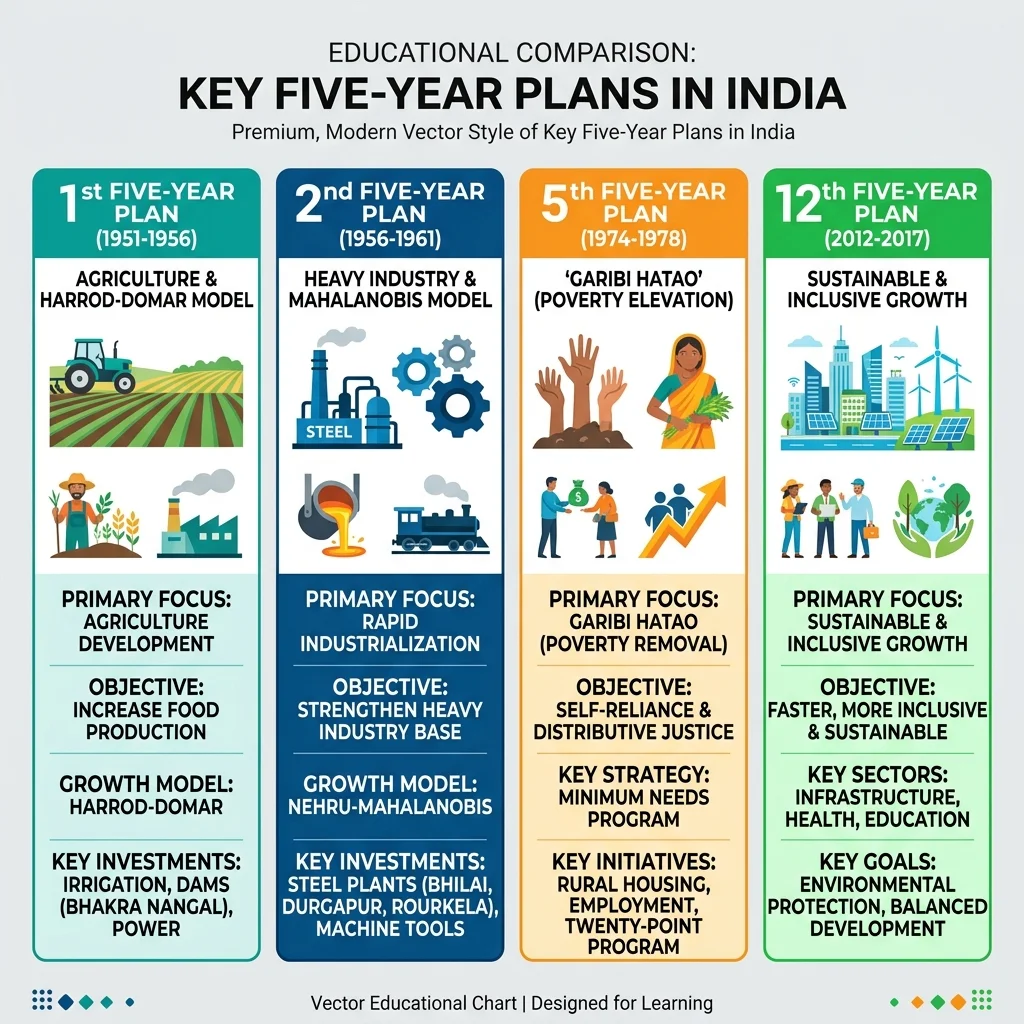
Key Plans & Milestones
- First Five-Year Plan (1951-1956): Based on the Harrod-Domar Model. Focused primarily on agriculture, irrigation, and power projects. Major multipurpose dam projects (Bhakra-Nangal, Hirakud, Mettur) were started. It exceeded its growth target.
- Second Five-Year Plan (1956-1961): Based on the Nehru-Mahalanobis Model. Focused on rapid industrialization and heavy/basic industries. Three major state-owned steel plants were established: Bhilai (with USSR help), Durgapur (with UK help), and Rourkela (with West Germany help).
- Third Five-Year Plan (1961-1966): Directed towards self-reliant growth. It failed due to external shocks: Sino-Indian War (1962), Indo-Pak War (1965), and severe droughts. This led to Plan Holidays (1966-1969) during which annual plans were implemented.
- Fourth Five-Year Plan (1969-1974): Aimed at growth with stability. Major milestones: Nationalization of 14 commercial banks (1969) and the launch of the Green Revolution.
- Fifth Five-Year Plan (1974-1978): Focused on Garibi Hatao (removal of poverty) and self-reliance. It was terminated one year early in 1978 by the new Janata Party government, which implemented the Rolling Plan (1978-1980).
- Sixth Five-Year Plan (1980-1985): Focused on poverty alleviation and economic liberalization. Major development institutions like NABARD (1982) and EXIM Bank (1982) were established.
- Eighth Five-Year Plan (1992-1997): Launched after the economic crisis of 1991 and the introduction of LPG Reforms (Liberalization, Privatization, Globalization) under PM P.V. Narasimha Rao. Top priority was given to Human Resource Development (education, health, employment).
- Twelfth Five-Year Plan (2012-2017): The final plan in India's history. Its theme was "Faster, More Inclusive and Sustainable Growth".
2. NITI Aayog (National Institution for Transforming India)
On January 1, 2015, the Union Government replaced the 65-year-old Planning Commission with the newly formed NITI Aayog.
- Structure: Headed by the Prime Minister of India (ex-officio Chairperson). The Governing Council comprises Chief Ministers of all States and Lt. Governors of Union Territories.
- Ideology: Moves away from the centralized, top-down planning approach of the Planning Commission. NITI Aayog acts as a policy think-tank and promotes cooperative federalism, utilizing a bottom-up planning model.
3. Union Budget & Deficit Accounting
Under Article 112, the President causes to be laid before Parliament the Annual Financial Statement (Budget) for each financial year. The budget is divided into:
- Revenue Budget: Consists of revenue receipts (tax revenues, non-tax revenues like interest, dividends) and revenue expenditures (interest payments, salaries, subsidies, defense maintenance - items that do not create assets or reduce liabilities).
- Capital Budget: Consists of capital receipts (borrowings, recovery of loans, disinvestment proceeds) and capital expenditures (investments in infrastructure, land acquisition, debt repayment - items that create assets or reduce liabilities).
Deficit Metrics
Deficits indicate gaps between government spending and receipts, crucial for CGL questions:
- Revenue Deficit: The excess of revenue expenditure over revenue receipts.
Revenue Deficit = Revenue Expenditure - Revenue Receipts. - Fiscal Deficit: The difference between the government's total expenditure and its total non-borrowed receipts. It reflects the total borrowing requirements of the government.
Fiscal Deficit = Total Expenditure - (Revenue Receipts + Capital Receipts excluding Borrowings). - Primary Deficit: Calculated by subtracting interest payments on past loans from the current fiscal deficit. It shows the government's borrowing needs excluding interest burdens.
Primary Deficit = Fiscal Deficit - Interest Payments.
4. Practice Questions (20 Premium Solved Questions)
Which economic growth model served as the foundational framework for the First Five-Year Plan of India (1951-1956)?
Step-by-step Solution
The Second Five-Year Plan (1956-1961), which prioritized heavy industries and rapid industrialization, was based on which model?
Step-by-step Solution
Under which Five-Year Plan of India were 14 major commercial banks nationalized by the Indira Gandhi government in 1969?
Step-by-step Solution
The slogan of 'Garibi Hatao' (Poverty Removal) was formally introduced in which of the following Five-Year Plans?
Step-by-step Solution
The period known as the 'Plan Holidays' in India's economic history refers to which of the following time frames?
Step-by-step Solution
During which Five-Year Plan was the National Bank for Agriculture and Rural Development (NABARD) established in 1982?
Step-by-step Solution
The Eighth Five-Year Plan (1992-1997) was launched immediately after the 1991 economic reforms. What was its top priority?
Step-by-step Solution
What was the official central theme of the Twelfth and final Five-Year Plan of India (2012-2017)?
Step-by-step Solution
NITI Aayog, which replaced the Planning Commission of India, was formally established on which date?
Step-by-step Solution
Who serves as the ex-officio Chairperson of NITI Aayog under its constitutional/administrative guidelines?
Step-by-step Solution
Which deficit represents the total borrowing requirements of the Government of India in a financial year?
Step-by-step Solution
How is the 'Primary Deficit' of a government calculated under standard budgetary accounting?
Step-by-step Solution
Interest payments made by the government on public debt are classified under which of the following budgetary items?
Step-by-step Solution
Which steel plant was established in Chhattisgarh with Soviet Union (USSR) assistance during the Second Five-Year Plan?
Step-by-step Solution
The 'Rolling Plan' was introduced in India by the Morarji Desai government in 1978. What was its duration?
Step-by-step Solution
Economic and Social Planning is a subject listed under which list of the Seventh Schedule of the Constitution of India?
Step-by-step Solution
Who was the first Deputy Chairman of the Planning Commission of India (established in March 1950)?
Step-by-step Solution
The concept of Economic Planning and Five-Year Plans in the Indian Constitution was adopted from which country?
Step-by-step Solution
What does the abbreviation NITI in NITI Aayog stand for?
Step-by-step Solution
Which Five-Year Plan of India was cut short and terminated one year ahead of its normal five-year schedule due to a change in government?
Step-by-step Solution
Strategy errors to avoid
Conflating Rolling Plan & Plan Holidays
Always associate the Plan Holidays with 1966-1969 (after 3rd Plan) and the Rolling Plan with 1978-1980 (by Janata government). Mixing these two non-plan periods is a classic CGL distractor.
Deficit Formulas Interchange
Memorize the definitions: Fiscal Deficit represents total borrowings. Primary Deficit is Fiscal Deficit MINUS Interest Payments. Interchanging these formulas will lead to negative marks in numerical questions.