Master Fundamental Rights & Duties for SSC CGL
Get comprehensive theory, expert shortcuts, and hand-picked practice questions for Fundamental Rights & Duties specifically designed for the SSC CGL 2025-26 pattern.
Fundamental Rights, Directive Principles (DPSP) & Duties
Part III, Part IV, and Part IV-A of the Indian Constitution form the core of the democratic rights and duties of Indian citizens. SSC CGL questions frequently test the specific Articles of Fundamental Rights, the philosophical classification of Directive Principles, and the history and clauses of the Fundamental Duties. This module compiles the essential theoretical framework, categories, and 20 practice questions.
Learning path
- Six Categories of Fundamental Rights
- Directive Principles of State Policy
- Fundamental Duties & Key Amendments
- 20 CGL-Pattern Solved Questions
1. Fundamental Rights (Articles 12-35)
Contained in Part III of the Constitution, Fundamental Rights are justiciable in nature, meaning they are enforceable by courts of law. The Constitution guarantees six basic groups of rights:
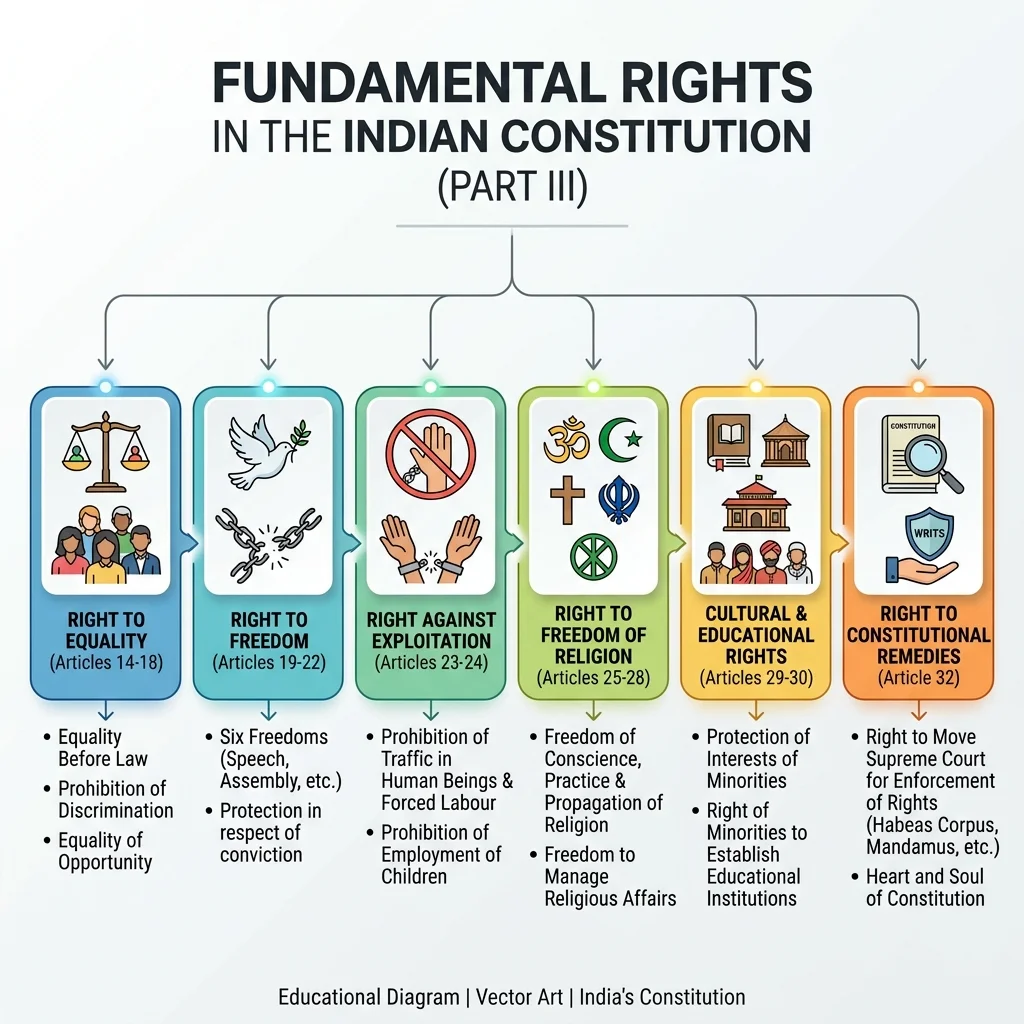
- Right to Equality (Articles 14-18):
- Article 14: Equality before law and equal protection of laws.
- Article 15: Prohibition of discrimination on grounds of religion, race, caste, sex, or place of birth.
- Article 16: Equality of opportunity in matters of public employment.
- Article 17: Abolition of untouchability.
- Article 18: Abolition of titles (except military and academic titles).
- Right to Freedom (Articles 19-22):
- Article 19: Guarantees 6 democratic freedoms (speech & expression, peaceful assembly, association/unions, movement throughout India, residence, and profession).
- Article 20: Protection in respect of conviction for offenses (protection against ex-post facto laws, double jeopardy, and self-incrimination).
- Article 21: Protection of life and personal liberty.
- Article 21A: Right to education for children aged 6 to 14 (Added by the 86th Amendment Act of 2002).
- Article 22: Protection against arrest and detention in certain cases.
- Right Against Exploitation (Articles 23-24):
- Article 23: Prohibition of traffic in human beings and forced labor (begar).
- Article 24: Prohibition of employment of children (below 14 years) in factories, mines, and hazardous jobs.
- Right to Freedom of Religion (Articles 25-28):
- Article 25: Freedom of conscience and free profession, practice, and propagation of religion.
- Article 26: Freedom to manage religious affairs.
- Cultural and Educational Rights (Articles 29-30): Protection of interests, language, and culture of minorities, and their right to establish educational institutions.
- Right to Constitutional Remedies (Article 32): Gives citizens the right to approach the Supreme Court for enforcement of rights. Dr. B.R. Ambedkar called Article 32 the "Heart and Soul of the Constitution". Under it, the Supreme Court issues writs (Habeas Corpus, Mandamus, Prohibition, Certiorari, Quo Warranto).
Suspension: During a National Emergency, all Fundamental Rights can be suspended, EXCEPT Articles 20 and 21, which remain active under all circumstances (established by the 44th Amendment Act of 1978).
Right to Property: Originally a Fundamental Right under Article 31, it was deleted by the 44th Amendment Act of 1978 and made a legal right under Article 300A in Part XII.
2. Directive Principles of State Policy (Articles 36-51)
Contained in Part IV, DPSPs are guidelines or directives to the central and state governments to establish a welfare state. Unlike Fundamental Rights, DPSPs are non-justiciable (cannot be enforced in a court of law).
They are broadly classified into three ideological categories:
- Socialistic Principles: Directives aimed at achieving social and economic justice (e.g., Article 39A - Equal justice and free legal aid, Article 41 - Right to work, Article 42 - Just and humane conditions of work and maternity relief).
- Gandhian Principles: Based on Gandhi's reconstruction program (e.g., Article 40 - Organization of village panchayats, Article 43B - Promotion of cooperative societies, Article 47 - Prohibition of consumption of intoxicating drinks and drugs).
- Liberal-Intellectual Principles: Based on modern liberalism (e.g., Article 44 - Uniform Civil Code for all citizens, Article 45 - Provision for early childhood care and education, Article 50 - Separation of judiciary from executive, Article 51 - Promotion of international peace and security).
3. Fundamental Duties (Part IV-A, Article 51A)
The original Constitution did not contain Fundamental Duties. They were added to Part IV-A by the 42nd Constitutional Amendment Act of 1976 on the recommendations of the Swaran Singh Committee.
Originally 10 in number, an 11th duty was added by the 86th Constitutional Amendment Act of 2002. Like DPSPs, Fundamental Duties are non-justiciable.
Key duties include:
- Abiding by the Constitution, respecting the National Flag and National Anthem.
- Cherishing the noble ideals of the freedom struggle.
- Upholding and protecting the sovereignty, unity, and integrity of India.
- Defending the country and rendering national service when called upon.
- Promoting harmony and spirit of common brotherhood; renouncing practices derogatory to the dignity of women.
- Valuing and preserving the rich heritage of our composite culture.
- Protecting and improving the natural environment (forests, lakes, wildlife).
- Developing scientific temper, humanism, and spirit of inquiry and reform.
- Safeguarding public property and abjuring violence.
- Striving towards excellence in all spheres of individual and collective activity.
- 11th Duty (Article 51A(k)): Duty of a parent or guardian to provide opportunities for education to his child/ward between the age of 6 and 14 years (Added in 2002).
4. Practice Questions (20 Premium Solved Questions)
Which article of the Indian Constitution guarantees 'Equality before Law' and 'Equal Protection of Laws' within the territory of India?
Step-by-step Solution
Which article of the Indian Constitution explicitly abolishes the social practice of 'Untouchability' and forbids its practice in any form?
Step-by-step Solution
How many democratic freedoms are currently guaranteed to Indian citizens under Article 19 of the Constitution?
Step-by-step Solution
Under which Article of the Constitution was the 'Right to Education' (RTE) inserted as a Fundamental Right in 2002?
Step-by-step Solution
Which article of the Constitution was described by Dr. B.R. Ambedkar as the 'heart and soul of the Constitution'?
Step-by-step Solution
Which pair of Fundamental Rights cannot be suspended or restricted even during a National Emergency declared under Article 352?
Step-by-step Solution
Fundamental Duties were incorporated into the Indian Constitution based on the recommendations of which of the following committees?
Step-by-step Solution
The Directive Principles of State Policy (DPSP) are listed under which Part of the Indian Constitution?
Step-by-step Solution
Which article under the Directive Principles of State Policy directs the State to secure a Uniform Civil Code (UCC) for all citizens throughout India?
Step-by-step Solution
The 86th Constitutional Amendment Act of 2002 introduced which of the following duties as the 11th Fundamental Duty?
Step-by-step Solution
Which article of the Constitution prohibits the employment of children below the age of 14 years in factories, mines, or other hazardous environments?
Step-by-step Solution
Which of the following describes the legal nature of the Directive Principles of State Policy (DPSP)?
Step-by-step Solution
By which amendment was the Right to Property removed from the list of Fundamental Rights and made a simple legal right?
Step-by-step Solution
Which article of the Directive Principles of State Policy deals with the 'Organization of village panchayats'?
Step-by-step Solution
Which article protects a person from being prosecuted and punished more than once for the same offense (protection against Double Jeopardy)?
Step-by-step Solution
Which article of the Constitution provides protection against self-incrimination (forcing an accused to be a witness against himself)?
Step-by-step Solution
Which fundamental right guarantees freedom of conscience and the right to freely profess, practice, and propagate religion?
Step-by-step Solution
The 42nd Amendment of 1976 added how many Fundamental Duties to the Indian Constitution originally?
Step-by-step Solution
Which article under the Directive Principles directs the State to secure the separation of the Judiciary from the Executive in public services?
Step-by-step Solution
Which article of DPSP directs the state to secure equal justice and provide free legal aid to the poor and weaker sections?
Step-by-step Solution
Strategy errors to avoid
Justiciability Confusion
Always remember: Fundamental Rights (Part III) are justiciable, while Directive Principles (Part IV) and Fundamental Duties (Part IV-A) are non-justiciable. This difference is frequently queried in statement-based questions.
Suspension Limits
Do not forget that Articles 20 and 21 cannot be suspended even during a National Emergency under Article 352. CGL exams often attempt to trick candidates by suggesting all rights are suspended.