Master Supreme Court & High Courts for SSC CGL
Get comprehensive theory, expert shortcuts, and hand-picked practice questions for Supreme Court & High Courts specifically designed for the SSC CGL 2025-26 pattern.
Indian Judiciary: Supreme Court, High Courts & Constitutional Writs
India possesses a single, integrated, and unified judicial system with the Supreme Court at the apex, followed by High Courts at the state level, and Subordinate Courts at the district level. For SSC CGL, candidates must learn the composition, appointments, jurisdictions, and retirement limits of judges, alongside the five core Constitutional Writs. This guide covers the key theory and features 20 solved questions.
Learning path
- Supreme Court Composition & Jurisdictions
- High Courts & Subordinate Judiciary
- Five Constitutional Writs (Articles 32 & 226)
- 20 CGL-Pattern Solved Questions
1. The Supreme Court of India (Articles 124-147)
Inaugurated on January 28, 1950, the Supreme Court of India replaced the Federal Court of India established under the Government of India Act of 1935.
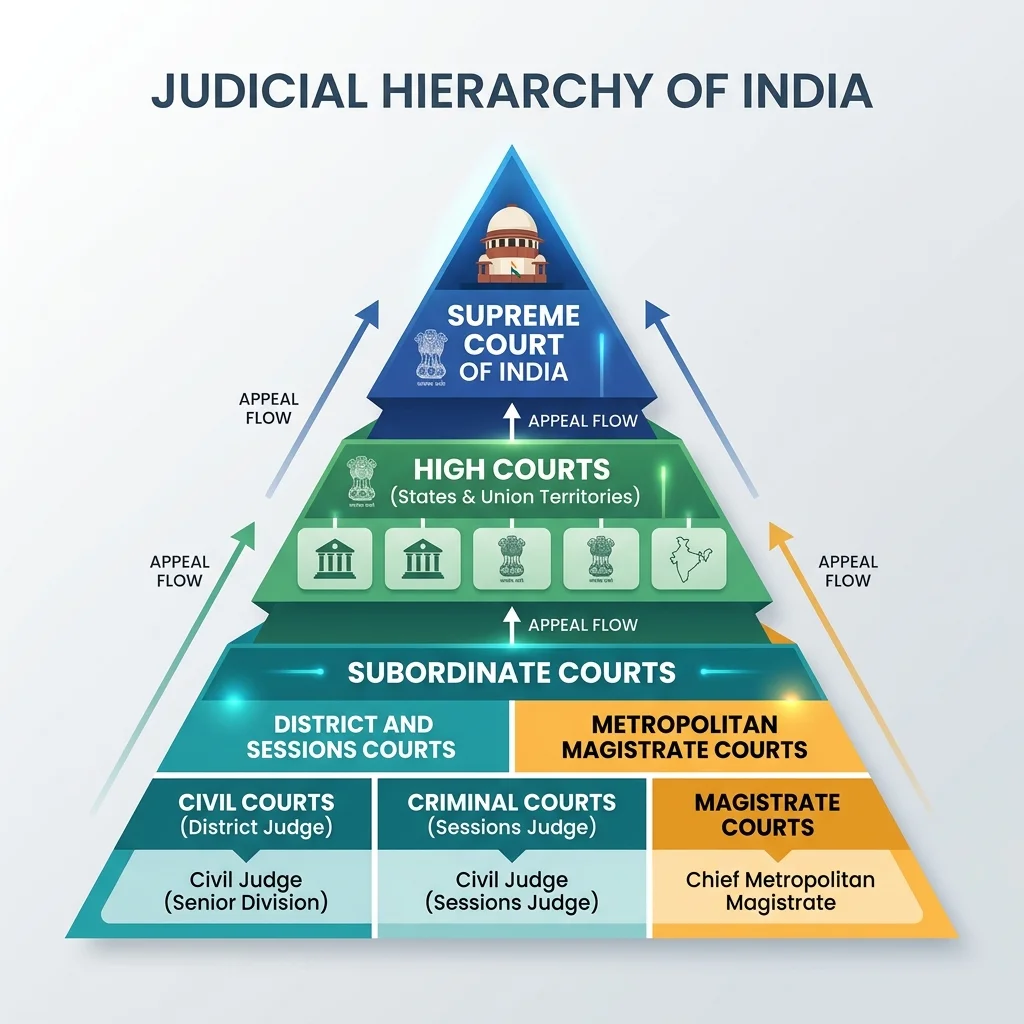
- Composition: Currently, the Supreme Court consists of 34 judges (1 Chief Justice of India and 33 other judges). The strength is determined by Parliament.
- Qualifications: Must be an Indian citizen. Must have been a Judge of a High Court for at least 5 years, OR an advocate of a High Court for 10 years, OR a distinguished jurist in the opinion of the President.
- Retirement Age: A Supreme Court judge holds office until he attains the age of 65 years.
- Jurisdictions:
- **Original Jurisdiction (Article 131):** Handles federal disputes (disputes between Centre and states, or between states).
- **Writ Jurisdiction (Article 32):** Can issue writs to enforce Fundamental Rights.
- **Advisory Jurisdiction (Article 143):** The President can refer questions of law or fact of public importance to the Supreme Court for its opinion (not binding on the President).
- **Court of Record (Article 129):** All judgments and proceedings of the Supreme Court are recorded for perpetual memory and testimony, and it has the power to punish for contempt.
2. High Courts & Subordinate Judiciary
The High Court is the highest judicial organ at the state level (Articles 214-231).
- Count: Currently, there are 25 High Courts in India. The latest is the Andhra Pradesh High Court established in Amaravati in 2019.
- Appointment: High Court judges are appointed by the President in consultation with the CJI, the State Governor, and the Chief Justice of the concerned High Court.
- Retirement Age: A High Court judge holds office until he attains the age of 62 years.
- Writ Jurisdiction (Article 226): The High Court can issue writs for the enforcement of Fundamental Rights as well as other legal rights. *Thus, the High Court's writ jurisdiction is broader in scope than the Supreme Court's.*
3. The Five Constitutional Writs
Writs are command orders issued by the courts to protect the fundamental liberties of individuals:
- Habeas Corpus (To have the body of): Issued to a person who has detained another person, directing them to produce the body of the latter before the court. Safeguards individual liberty against arbitrary detention.
- Mandamus (We Command): Issued by the court to a public official, commanding him to perform his official duty which he has failed or refused to perform.
- Prohibition (To Forbid): Issued by a higher court to a lower court or tribunal to prevent it from exceeding its jurisdiction. Can be issued only against judicial and quasi-judicial authorities.
- Certiorari (To be Certified / Informed): Issued by a higher court to a lower court to transfer a case pending with the latter to itself or to quash its order. Issued on grounds of excess of jurisdiction or error of law.
- Quo Warranto (By what authority / warrant): Issued by the court to enquire into the legality of the claim of a person to a public office. Prevents illegal usurpation of a public office by a person.
4. Practice Questions (20 Premium Solved Questions)
What is the retirement age of a Judge of the Supreme Court of India?
Step-by-step Solution
What is the retirement age of a Judge of a High Court in India?
Step-by-step Solution
Under which Article of the Indian Constitution does the President seek the advisory opinion of the Supreme Court on questions of law or public importance?
Step-by-step Solution
Which Article of the Constitution empowers the State High Courts to issue writs for the enforcement of Fundamental Rights and other legal rights?
Step-by-step Solution
How many High Courts are there in India at present?
Step-by-step Solution
Which of the following writs is issued by a court to release a person who has been illegally or arbitrarily detained?
Step-by-step Solution
What does the Latin name of the writ 'Mandamus' literally translate to in English?
Step-by-step Solution
Which writ is issued by a higher court to prevent a lower court or tribunal from exceeding its jurisdiction or usurping jurisdiction it does not possess?
Step-by-step Solution
Which writ is issued by the court to inquire into the legality of a person's claim to a public office, preventing illegal usurpation?
Step-by-step Solution
Who was the Chief Justice of India during whose tenure Public Interest Litigation (PIL) was introduced to the Indian judicial system?
Step-by-step Solution
Under which Article of the Indian Constitution is the Supreme Court declared to be a 'Court of Record'?
Step-by-step Solution
A dispute between the Government of India and one or more States falls under which jurisdiction of the Supreme Court?
Step-by-step Solution
Who was the first Chief Justice of India (CJI) appointed after the creation of the Supreme Court in 1950?
Step-by-step Solution
Who was the first female Judge appointed to the Supreme Court of India?
Step-by-step Solution
Under which Article of the Constitution are High Courts declared to be 'Courts of Record'?
Step-by-step Solution
Who appoints the Judges of the state High Courts under the Indian Constitution?
Step-by-step Solution
The power of 'Judicial Review' allows the judiciary to do which of the following?
Step-by-step Solution
The salaries, allowances, and pensions of the Judges of the Supreme Court are charged upon the:
Step-by-step Solution
Which writ is issued by a higher court to a lower court to quash an order already passed by it?
Step-by-step Solution
Who is the only Chief Justice of India to have served as the acting President of India?
Step-by-step Solution
Strategy errors to avoid
Writ Scope Difference
Always remember: the High Court's writ scope under Article 226 is broader than the Supreme Court's under Article 32. The Supreme Court can issue writs only for Fundamental Rights, whereas High Courts can issue them for ordinary legal rights too.
Prohibition vs. Certiorari
Keep their timing distinct. Prohibition is issued while the case is in progress to stop proceedings. Certiorari is issued after a decision has been made, to quash the lower court's final order.