Theory & Concepts

Master Basic Economics (GDP, Inflation, Taxation) for SSC CGL

Get comprehensive theory, expert shortcuts, and hand-picked practice questions for Basic Economics (GDP, Inflation, Taxation) specifically designed for the SSC CGL 2025-26 pattern.

25+
Exams Covered
100+
Study Modules
5K+
Practice Notes
35 min readGK: EconomicsWeightage: High

Basic Economics: National Income (GDP), Inflation & Taxation

Basic micro and macroeconomics forms a key pillar of the General Awareness section in SSC CGL. Highly tested areas include national income accounting concepts (GDP, GNP, NNP), inflation metrics (WPI, CPI, stagflation), and the structure of direct/indirect taxation in India, especially the Goods and Services Tax (GST). This guide breaks down the core theories and compiles 20 CGL-pattern questions.

Learning path

  • GDP, GNP, NNP & National Income
  • CPI, WPI, Types of Inflation & Stagflation
  • Direct vs. Indirect Taxes & GST Council
  • 20 CGL-Pattern Solved Questions

1. National Income Accounting

National Income is the total value of all final goods and services produced by a country in a financial year. Understanding the distinct definitions of aggregates is essential:

  • Gross Domestic Product (GDP): The total market value of all final goods and services produced within the domestic boundaries of a country in a year, regardless of who produces them (citizens or foreigners).
  • Gross National Product (GNP): The total value of final goods and services produced by the normal residents of a country, regardless of geographic location.
    GNP = GDP + Net Factor Income from Abroad (NFIA).
  • Net National Product (NNP): Calculated by deducting depreciation (wear and tear of capital assets) from GNP.
    NNP = GNP - Depreciation.
  • National Income (NI): NNP calculated at Factor Cost (actual cost of production, excluding indirect taxes and including subsidies) is officially defined as the National Income of India.
    National Income = NNP at Market Price - Indirect Taxes + Subsidies.
  • Nominal vs. Real GDP: Nominal GDP is calculated using current year market prices, while Real GDP is calculated using base year prices (constant prices). Real GDP is adjusted for inflation and represents actual volume growth. The ratio of the two is the GDP Deflator = (Nominal GDP / Real GDP) x 100.

2. Inflation: Concepts, WPI & CPI

Inflation is a persistent rise in the general price level of goods and services, leading to a decline in the purchasing power of money.

Measurement in India

  • Wholesale Price Index (WPI): Measures average price changes of goods at the wholesale level (first stage of transaction). Base year is 2011-12. Prepared and published weekly/monthly by the Office of Economic Adviser, Ministry of Commerce and Industry. *WPI does not include services.*
  • Consumer Price Index (CPI): Measures average price changes of goods and services at the retail level (final consumer purchase). Published monthly by the National Statistical Office (NSO), Ministry of Statistics and Programme Implementation. *CPI includes both goods and services.* It is used by the RBI as the primary index to track inflation for monetary policy.

Types & Terms of Inflation

  • Demand-Pull Inflation: Occurs when aggregate demand for goods and services outpaces aggregate supply ("too much money chasing too few goods").
  • Cost-Push Inflation: Occurs when the cost of production inputs (raw materials, wages) increases, causing producers to raise final prices.
  • Stagflation: A highly unfavorable economic situation characterized by slow economic growth/stagnation, high unemployment, and high inflation.
  • Disinflation: A temporary slowing of the rate of inflation (e.g., inflation falling from 6% to 4%; prices are still rising, but at a slower rate). This is distinct from Deflation, which is a general decline in prices (negative inflation).

3. Direct vs. Indirect Taxation & GST

Taxes are the primary source of revenue for the government, divided into two categories based on shifting of tax liability:
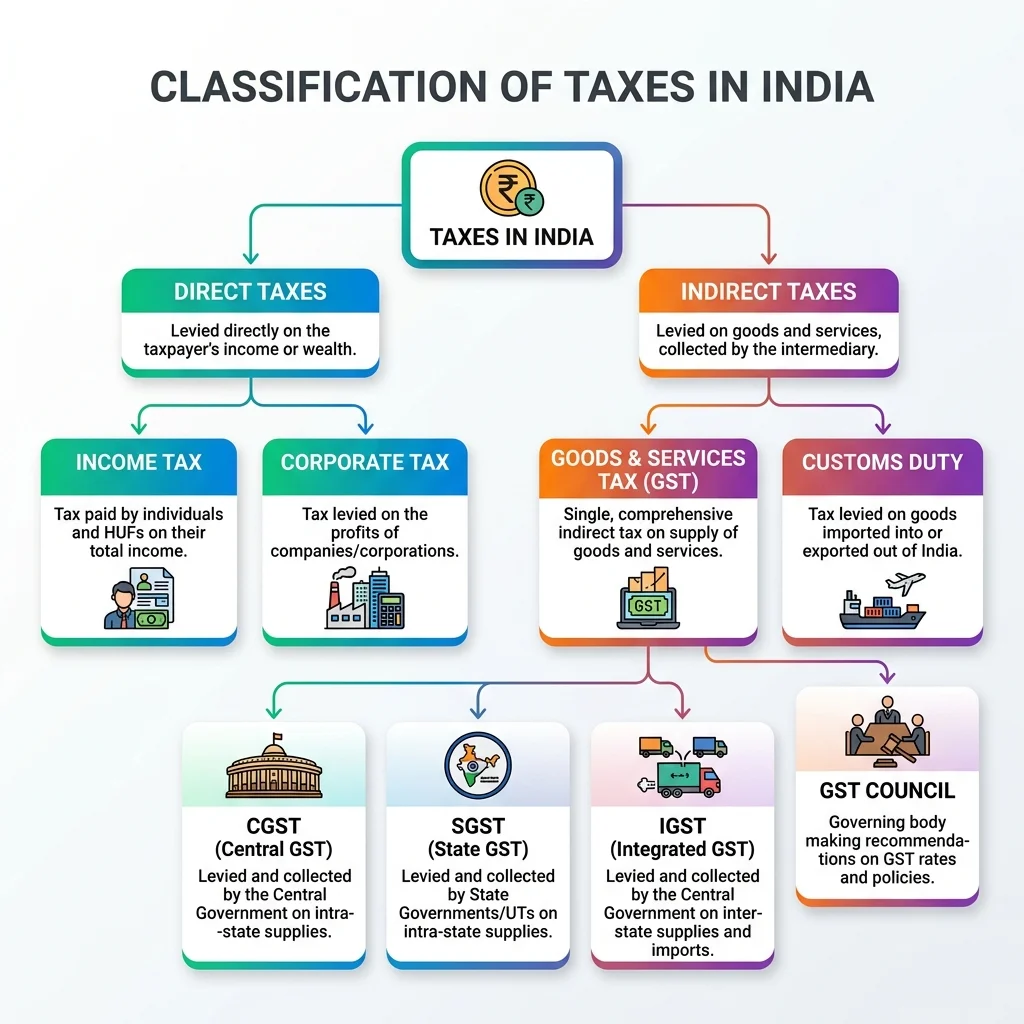
Direct and Indirect Taxation Flowchart
Visualizing the division between direct (non-shiftable) and indirect (shiftable) taxes, alongside the structure of the Goods and Services Tax (GST).
  • Direct Taxes: Taxes where the liability to pay and the ultimate incidence of the tax fall on the same person (burden cannot be shifted). Examples: Income Tax, Corporate Tax, Securities Transaction Tax (STT), and Capital Gains Tax. Administered by the Central Board of Direct Taxes (CBDT).
  • Indirect Taxes: Taxes where the liability to pay is on one entity, but the tax burden is passed on to the final consumer. Examples: Customs Duty, and GST. Administered by the Central Board of Indirect Taxes and Customs (CBIC).
  • Goods and Services Tax (GST): Introduced by the 101st Constitutional Amendment Act of 2016 and implemented on 1 July 2017. It is a comprehensive, multi-stage, destination-based tax that subsumed major state and central indirect taxes (excise, service tax, VAT, luxury tax).
    • Components: CGST (Central GST), SGST (State GST), UTGST (Union Territory GST), and IGST (Integrated GST, levied by the Centre on inter-state trade).
    • Slab Rates: 0% (essential items), 5%, 12%, 18%, and 28%. Luxury and demerit goods attract additional cess.
    • GST Council (Article 279A): A constitutional body that makes recommendations on GST rates, rules, and exemptions. It is chaired by the Union Finance Minister and includes state finance ministers. The Central Government has 1/3rd voting power, and State Governments collectively have 2/3rd voting power. Decisions require a 3/4th majority.

4. Practice Questions (20 Premium Solved Questions)

Question 01CGL Pattern

Which of the following aggregates is officially defined as the 'National Income' of India?

A) GDP at Market Price
B) NNP at Market Price
C) NNP at Factor Cost
D) GNP at Factor Cost
Correct answer: C) NNP at Factor Cost

Step-by-step Solution

Step 1: Understand the difference between domestic/national and market price/factor cost.
Step 2: National Income represents the total income earned by the normal residents of a country.
Step 3: To arrive at this, we take Net National Product (NNP) and evaluate it at Factor Cost (excluding indirect taxes and including subsidies).
Conclusion: NNP at Factor Cost is defined as National Income. Option C is correct.
Question 02CGL Pattern

What is the correct mathematical formula to calculate the Net National Product (NNP) of an economy?

A) NNP = GDP - Depreciation
B) NNP = GNP - Depreciation
C) NNP = GDP + Net Factor Income from Abroad
D) NNP = NNP + Subsidies
Correct answer: B) NNP = GNP - Depreciation

Step-by-step Solution

Step 1: 'Net' in national income accounting implies that depreciation is subtracted.
Step 2: 'National' indicates that we use Gross National Product (GNP) rather than Gross Domestic Product (GDP).
Step 3: Therefore, NNP is equal to GNP minus Depreciation.
Conclusion: Option B is correct.
Question 03CGL Pattern

The difference between Gross Domestic Product (GDP) and Gross National Product (GNP) is equal to which of the following factors?

A) Indirect Taxes
B) Subsidies
C) Depreciation
D) Net Factor Income from Abroad (NFIA)
Correct answer: D) Net Factor Income from Abroad (NFIA)

Step-by-step Solution

Step 1: GDP measures production within domestic boundaries.
Step 2: GNP measures production by citizens globally.
Step 3: The bridge between them is the net income earned by domestic residents abroad minus the income earned by foreign residents domestically, which is Net Factor Income from Abroad (NFIA).
Conclusion: Option D is correct.
Question 04CGL Pattern

Nominal GDP of a country is calculated on the basis of which of the following pricing levels?

A) Base-year Constant Prices
B) Current-year Market Prices
C) Wholesale Price Levels
D) Factor Cost Levels
Correct answer: B) Current-year Market Prices

Step-by-step Solution

Step 1: Nominal GDP represents the raw market value of output in current prices without adjusting for inflation.
Step 2: Real GDP evaluates output using constant prices of a base year, filtering out inflation effects.
Conclusion: Option B is correct.
Question 05CGL Pattern

Which of the following indexes is utilized by the Reserve Bank of India (RBI) as the key metric for calculating inflation and deciding monetary policy rates?

A) Wholesale Price Index (WPI)
B) Consumer Price Index (CPI)
C) Producer Price Index (PPI)
D) GDP Deflator
Correct answer: B) Consumer Price Index (CPI)

Step-by-step Solution

Step 1: Historically, RBI used WPI, but adopted CPI (Combined) under Governor Raghuram Rajan in 2014 based on the Urjit Patel committee recommendations.
Step 2: CPI reflects the retail prices paid by consumers and includes services, making it a better measure of cost of living than WPI.
Conclusion: Option B is correct.
Question 06CGL Pattern

The Wholesale Price Index (WPI) in India is published monthly by which of the following offices?

A) National Statistical Office (NSO)
B) Office of Economic Adviser, Ministry of Commerce and Industry
C) Department of Financial Services
D) NITI Aayog
Correct answer: B) Office of Economic Adviser, Ministry of Commerce and Industry

Step-by-step Solution

Step 1: Check publishing bodies. NSO publishes CPI.
Step 2: The Office of the Economic Adviser (OEA) under the Ministry of Commerce and Industry publishes the Wholesale Price Index (WPI).
Conclusion: Option B is correct.
Question 07CGL Pattern

Which term describes a highly unfavorable economic situation where slow economic growth, high unemployment, and high inflation occur simultaneously?

A) Deflation
B) Reflation
C) Stagflation
D) Hyperinflation
Correct answer: C) Stagflation

Step-by-step Solution

Step 1: Break down the word: Stagnation + Inflation.
Step 2: In standard Keynesian economics, inflation is associated with high growth and low unemployment. However, stagflation violates this, presenting low growth/stagnant output, high unemployment, and rising prices.
Conclusion: Option C is correct.
Question 08CGL Pattern

The Goods and Services Tax (GST) in India was introduced through which of the following Constitutional Amendment Acts?

A) 99th Amendment Act
B) 100th Amendment Act
C) 101st Amendment Act
D) 102nd Amendment Act
Correct answer: C) 101st Amendment Act

Step-by-step Solution

Step 1: The GST bill was passed as the 122nd Amendment Bill in Parliament.
Step 2: Upon receiving presidential assent, it was enacted as the 101st Constitutional Amendment Act of 2016.
Conclusion: Option C is correct.
Question 09CGL Pattern

On which date did the Goods and Services Tax (GST) officially roll out and replace the old indirect tax regime in India?

A) 1 April 2017
B) 1 July 2017
C) 15 August 2017
D) 1 January 2018
Correct answer: B) 1 July 2017

Step-by-step Solution

Step 1: The GST Act was enacted in 2016.
Step 2: The tax officially came into force on the midnight of 1 July 2017, celebrated in a special joint session of Parliament.
Conclusion: Option B is correct.
Question 10CGL Pattern

Under which Article of the Indian Constitution is the GST Council established as a joint forum of the Centre and States?

A) Article 246A
B) Article 269A
C) Article 279A
D) Article 280
Correct answer: C) Article 279A

Step-by-step Solution

Step 1: Article 246A grants states power to levy GST; Article 269A governs GST on inter-state trade.
Step 2: Article 279A directs the President to constitute the GST Council within 60 days of the amendment.
Step 3: Article 280 is for the Finance Commission.
Conclusion: Option C is correct.
Question 11CGL Pattern

Who is designated as the ex-officio Chairperson of the GST Council under Article 279A?

A) Prime Minister of India
B) Union Finance Minister
C) Governor of the Reserve Bank of India
D) Comptroller and Auditor General of India
Correct answer: B) Union Finance Minister

Step-by-step Solution

Step 1: The GST Council consists of Union and State representatives.
Step 2: The Union Finance Minister serves as the Chairperson, and the Union Minister of State in charge of Revenue/Finance is a member.
Conclusion: Option B is correct.
Question 12CGL Pattern

Which of the following is categorized as a Direct Tax in India?

A) Customs Duty
B) Goods and Services Tax (GST)
C) Corporate Tax
D) Excise Duty
Correct answer: C) Corporate Tax

Step-by-step Solution

Step 1: Direct taxes are paid directly by the earning entity and cannot be shifted.
Step 2: Corporate tax (tax on company profits) and Income tax are direct.
Step 3: Customs duty, GST, and Excise duty are indirect taxes passed to consumers.
Conclusion: Option C is correct.
Question 13CGL Pattern

Which of the following is NOT one of the three standard methods used to calculate the National Income of a country?

A) Income Method
B) Expenditure Method
C) Malthusian Method
D) Value Added Method
Correct answer: C) Malthusian Method

Step-by-step Solution

Step 1: The three methods are: Income (sum of wages, rent, interest, profit), Expenditure (C + I + G + NX), and Value Added/Product method (sum of value added at each production stage).
Step 2: The Malthusian theory relates to population growth, not national income calculation.
Conclusion: Option C is correct.
Question 14CGL Pattern

What is the primary difference between Real GDP and Nominal GDP?

A) Real GDP is calculated at factor cost, Nominal is at market price.
B) Real GDP is adjusted for inflation using base year prices, Nominal uses current prices.
C) Nominal GDP includes service sector, Real excludes it.
D) Real GDP is calculated by NSO, Nominal by RBI.
Correct answer: B) Real GDP is adjusted for inflation using base year prices, Nominal uses current prices.

Step-by-step Solution

Step 1: Nominal GDP changes due to both volume change and price change.
Step 2: Real GDP holds prices constant at a base year, meaning changes reflect only actual physical volume of production (growth).
Conclusion: Option B is correct.
Question 15CGL Pattern

The GDP Deflator is mathematically expressed as which of the following ratios?

A) (Real GDP / Nominal GDP) x 100
B) (Nominal GDP / Real GDP) x 100
C) (GDP / GNP) x 100
D) (GNP / NNP) x 100
Correct answer: B) (Nominal GDP / Real GDP) x 100

Step-by-step Solution

Step 1: The GDP deflator measures the level of prices of all new, domestically produced, final goods and services in an economy.
Step 2: It is calculated by dividing Nominal GDP by Real GDP and multiplying by 100.
Conclusion: Option B is correct.
Question 16CGL Pattern

Inflation that occurs when the cost of production factors (wages, raw materials) rises, forcing businesses to raise prices, is called:

A) Demand-pull inflation
B) Cost-push inflation
C) Structural inflation
D) Galloping inflation
Correct answer: B) Cost-push inflation

Step-by-step Solution

Step 1: Inflation driven by rising input costs is cost-push inflation.
Step 2: Demand-pull is driven by excess monetary demand. Structural is due to bottlenecks (storage, cartels).
Conclusion: Option B is correct.
Question 17CGL Pattern

What is the current base year used by the Central Government to calculate the Consumer Price Index (CPI) in India?

A) 2004-05
B) 2011-12
C) 2012
D) 2015
Correct answer: C) 2012

Step-by-step Solution

Step 1: Review base years. WPI uses 2011-12.
Step 2: The Consumer Price Index (CPI) uses 2012 as the base year (base value = 100).
Conclusion: Option C is correct.
Question 18CGL Pattern

Which index measures the average change over time in the selling prices received by domestic producers for their output before reaching the consumer?

A) CPI
B) WPI
C) PPI (Producer Price Index)
D) GDP Deflator
Correct answer: C) PPI (Producer Price Index)

Step-by-step Solution

Step 1: The Producer Price Index (PPI) measures price changes from the perspective of the seller/producer rather than the wholesale buyer (WPI) or retail consumer (CPI).
Conclusion: Option C is correct.
Question 19CGL Pattern

Direct taxes like Income Tax and Corporate Tax are administered in India by which administrative board?

A) CBIC
B) CBDT
C) SEBI
D) RBI
Correct answer: B) CBDT

Step-by-step Solution

Step 1: The Central Board of Direct Taxes (CBDT) is a statutory authority functioning under the Central Board of Revenue Act, 1963.
Step 2: It is responsible for administering direct tax laws through the Income Tax Department.
Conclusion: Option B is correct.
Question 20CGL Pattern

In the GST Council, what is the weightage of the voting power of the Central Government in decisions?

A) One-fourth (1/4)
B) One-third (1/3)
C) Two-thirds (2/3)
D) Half (1/2)
Correct answer: B) One-third (1/3)

Step-by-step Solution

Step 1: Decision making in the GST council is based on weighted votes.
Step 2: The vote of the Central Government has a weightage of 1/3rd of the total votes cast.
Step 3: The votes of all the State Governments taken together have a weightage of 2/3rd of the total votes cast.
Conclusion: Option B is correct.

Strategy errors to avoid

!

Conflating CPI & WPI Publish Bodies

Do not mix up CPI and WPI publishers. WPI is published by the Office of Economic Adviser (OEA) under the Ministry of Commerce. CPI is published by the National Statistical Office (NSO) under MOSPI. This distinction is a recurring CGL test point.

!

Real vs. Nominal GDP Formula

Ensure you write the GDP deflator as (Nominal/Real) x 100. Inverting this formula is a common exam trap. Always remember that Nominal GDP is on top because it uses current, unadjusted prices.