Master Panchayati Raj System for SSC CGL
Get comprehensive theory, expert shortcuts, and hand-picked practice questions for Panchayati Raj System specifically designed for the SSC CGL 2025-26 pattern.
Panchayati Raj System & Urban Local Governance
Local self-government (Panchayats and Municipalities) constitutes the third tier of federalism in India. For SSC CGL, candidates must learn the recommendation milestones of the Balwant Rai Mehta and Ashok Mehta committees, the specific provisions introduced by the 73rd and 74th Amendment Acts of 1992, and the details of the three-tier administrative division. This module compiles the complete theory and 20 practice questions.
Learning path
- Evolution & Committee Milestones
- 73rd Amendment & Three-Tier System
- 74th Amendment & Municipalities
- 20 CGL-Pattern Solved Questions
1. Evolution of Local Self-Government
Following the failure of the Community Development Programme (1952) and the National Extension Service (1953) due to lack of public participation, the government appointed several committees to recommend local governance structures:
- Balwant Rai Mehta Committee (1957): Recommended the establishment of a **Three-Tier Panchayati Raj System** under "Democratic Decentralization". First inaugurated in **Nagaur district, Rajasthan** on October 2, 1959 by PM Jawaharlal Nehru, followed by Andhra Pradesh.
- Ashok Mehta Committee (1977): Appointed by the Janata government. Recommended replacing the three-tier system with a **Two-Tier System** consisting of Zilla Parishad at the district level and Mandal Panchayat at the intermediate level.
- G.V.K. Rao Committee (1985): Noted that development administration had become bureaucratic, calling it "grass without roots".
- L.M. Singhvi Committee (1986): Recommended that Panchayati Raj Institutions should be **constitutionally recognized and protected**. It also advocated for the creation of Nyaya Panchayats.
2. 73rd Amendment Act of 1992
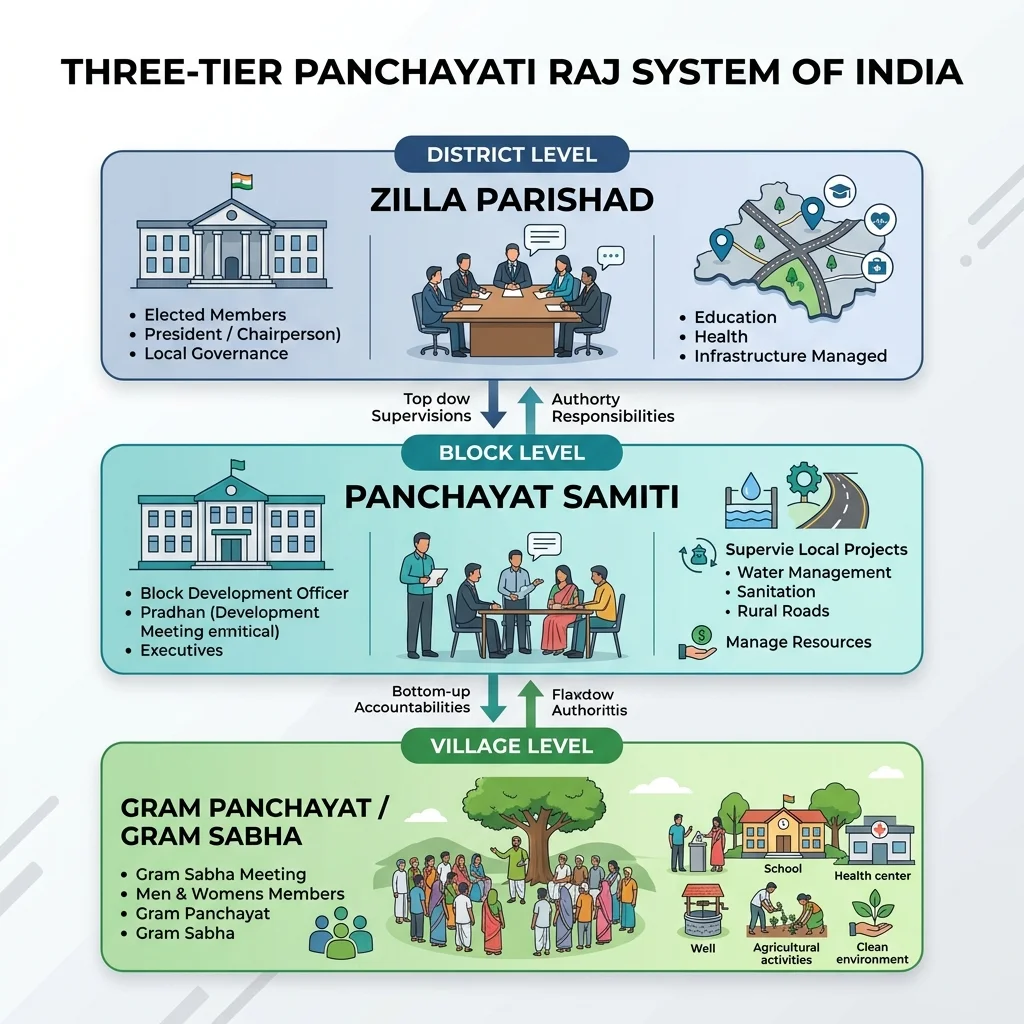
The 73rd Constitutional Amendment Act of 1992 gave constitutional status to Panchayati Raj Institutions. It added Part IX (Articles 243 to 243O) and the 11th Schedule (containing 29 functional items).
Salient Features
- Gram Sabha: The foundation of the system. It is a village assembly consisting of all registered voters in the area of the panchayat.
- Three-Tier System: Consists of Gram Panchayat (village level, directly elected), Panchayat Samiti (block level, indirectly elected), and Zilla Parishad (district level, indirectly elected). States with a population under 20 lakhs may choose not to constitute the intermediate block tier.
- Reservation of Seats (Article 243D): Seats are reserved for SCs and STs in proportion to their population. **Not less than one-third (1/3rd) of the total seats must be reserved for women.**
- Qualifications (Article 243F): The minimum age to contest elections to a Panchayat is 21 years (unlike 25 years for the Lok Sabha).
- Election (Article 243K): Conducted by the **State Election Commission**, which is appointed by the Governor. The term of a Panchayat is 5 years. If dissolved earlier, fresh elections must be held within **6 months**.
- State Finance Commission (Article 243I): Appointed by the Governor every 5 years to review the financial position of the Panchayats and recommend tax/grant distribution.
3. 74th Amendment Act of 1992 (Municipalities)
The 74th Constitutional Amendment Act of 1992 gave constitutional status to urban local bodies. It added Part IX-A (Articles 243P to 243ZG) and the 12th Schedule (containing 18 functional items).
It mandates three types of urban local bodies:
- Nagar Panchayat: For a transitional area (an area in transition from rural to urban).
- Municipal Council (Nagar Palika): For a smaller urban area.
- Municipal Corporation (Mahanagar Palika): For a larger urban area (e.g., Delhi, Mumbai). The political head is the **Mayor**, and the administrative head is the Municipal Commissioner.
4. Practice Questions (20 Premium Solved Questions)
Which committee appointed in 1957 first recommended the establishment of a Three-Tier Panchayati Raj system in India under democratic decentralization?
Step-by-step Solution
In which district and state of India was the Panchayati Raj system first inaugurated on October 2, 1959 by Prime Minister Jawaharlal Nehru?
Step-by-step Solution
The 73rd Constitutional Amendment Act of 1992 inserted which Part to the Constitution of India?
Step-by-step Solution
Which schedule was added to the Constitution of India by the 73rd Amendment Act, detailing 29 functional matters of Panchayats?
Step-by-step Solution
What is the minimum age prescribed under the Constitution for a person to be eligible to contest elections to a Panchayat?
Step-by-step Solution
What is the normal term/duration of a Panchayat from the date of its first meeting?
Step-by-step Solution
Under which Article of the Constitution does the State Governor constitute a State Finance Commission to review the financial position of Panchayats?
Step-by-step Solution
Which Article of the Constitution mandates the reservation of not less than one-third of the total number of seats in Panchayats for women?
Step-by-step Solution
The superintendence, direction, and control of the preparation of electoral rolls and the conduct of all elections to Panchayats are vested in the:
Step-by-step Solution
Which committee appointed in 1977 recommended a Two-Tier Panchayati Raj system, consisting of Zilla Parishad at the district level and Mandal Panchayat at the base?
Step-by-step Solution
Which committee first recommended that Panchayati Raj Institutions should be given constitutional recognition to ensure their regular elections and protection?
Step-by-step Solution
The 74th Constitutional Amendment Act of 1992 added which Schedule to the Constitution of India?
Step-by-step Solution
Which Part was added to the Constitution of India by the 74th Amendment Act to govern Municipalities?
Step-by-step Solution
Who among the following constitutes the membership of a 'Gram Sabha' under the provisions of the Constitution?
Step-by-step Solution
If a Panchayat is dissolved before its 5-year term, within what maximum period must elections be held to reconstitute it?
Step-by-step Solution
What is the name of the intermediate tier of the Panchayati Raj system, situated between the Gram Panchayat and the Zilla Parishad?
Step-by-step Solution
The apex body of the three-tier Panchayati Raj system, established at the district level, is the:
Step-by-step Solution
Which article of the Directive Principles of State Policy (DPSP) directed the State to organize village panchayats?
Step-by-step Solution
National Panchayati Raj Day is celebrated annually in India on which date?
Step-by-step Solution
Which of the following urban local bodies is established for a transition area (an area transitioning from rural to urban)?
Step-by-step Solution
Strategy errors to avoid
Age and Dissolution Election Terms
Remember that the minimum age to contest local elections is 21 (Article 243F), NOT 25. Also, if a Panchayat is dissolved early, elections must be held within 6 months, and the new body serves only the remainder of the term, not a fresh 5 years.
Commission Differences
Always associate state local elections with the State Election Commission (Article 243K), and review with the State Finance Commission (Article 243I). The ECI (Article 324) and Union Finance Commission (Article 280) have no jurisdiction over municipal/panchayat governance.