Theory & Concepts

Master Banking & RBI for SSC CGL

Get comprehensive theory, expert shortcuts, and hand-picked practice questions for Banking & RBI specifically designed for the SSC CGL 2025-26 pattern.

25+
Exams Covered
100+
Study Modules
5K+
Practice Notes
35 min readGK: EconomicsWeightage: High

Banking in India: Evolution, RBI & Monetary Policy

The banking sector and the functions of the central bank are core topics in the SSC CGL general awareness syllabus. Candidates must master the historical timeline of bank nationalization, the origin and administrative structure of the Reserve Bank of India (RBI), and the mechanics of monetary policy instruments (Repo, CRR, SLR) used to regulate inflation and liquidity. This guide details these concepts alongside 20 solved practice questions.

Learning path

  • Banking History & Nationalization
  • RBI Establishment, Governors & Functions
  • Quantitative vs. Qualitative Policy Tools
  • 20 CGL-Pattern Solved Questions

1. Evolution & Nationalization of Banking

Modern banking in India began with the establishment of the Bank of Hindustan in 1770. The three Presidency Banks (Bank of Bengal, Bank of Bombay, and Bank of Madras) were merged in 1921 to form the Imperial Bank of India, which was nationalized in 1955 and renamed the State Bank of India (SBI).

Key Bank Nationalization Phases

To ensure credit availability to rural and priority sectors, the government undertook two major phases of bank nationalization:

  • First Phase (July 19, 1969): Nationalization of 14 major commercial banks with deposits exceeding Rs. 50 crore, under PM Indira Gandhi.
  • Second Phase (April 15, 1980): Nationalization of 6 commercial banks with deposits exceeding Rs. 200 crore.

2. The Reserve Bank of India (RBI)

The RBI is India's central bank and the regulatory authority of the banking system.

  • Establishment: Set up on April 1, 1935 in Calcutta (moved to Bombay in 1937) under the RBI Act, 1934, on the recommendation of the Hilton Young Commission (Royal Commission on Indian Currency and Finance).
  • Nationalization: Transferred to public ownership on January 1, 1949.
  • Key Officers: First Governor was Sir Osborne Smith. The first Indian Governor was C.D. Deshmukh.
  • Core Functions: Monopoly of note issue (except one-rupee notes and coins, which are issued by the Ministry of Finance and bear the signature of the Finance Secretary), banker to the government, banker's bank, controller of credit and custodian of foreign exchange reserves.

3. Monetary Policy Instruments

The RBI formulated monetary policy to maintain price stability while keeping growth in mind. The instruments are divided into two main categories:
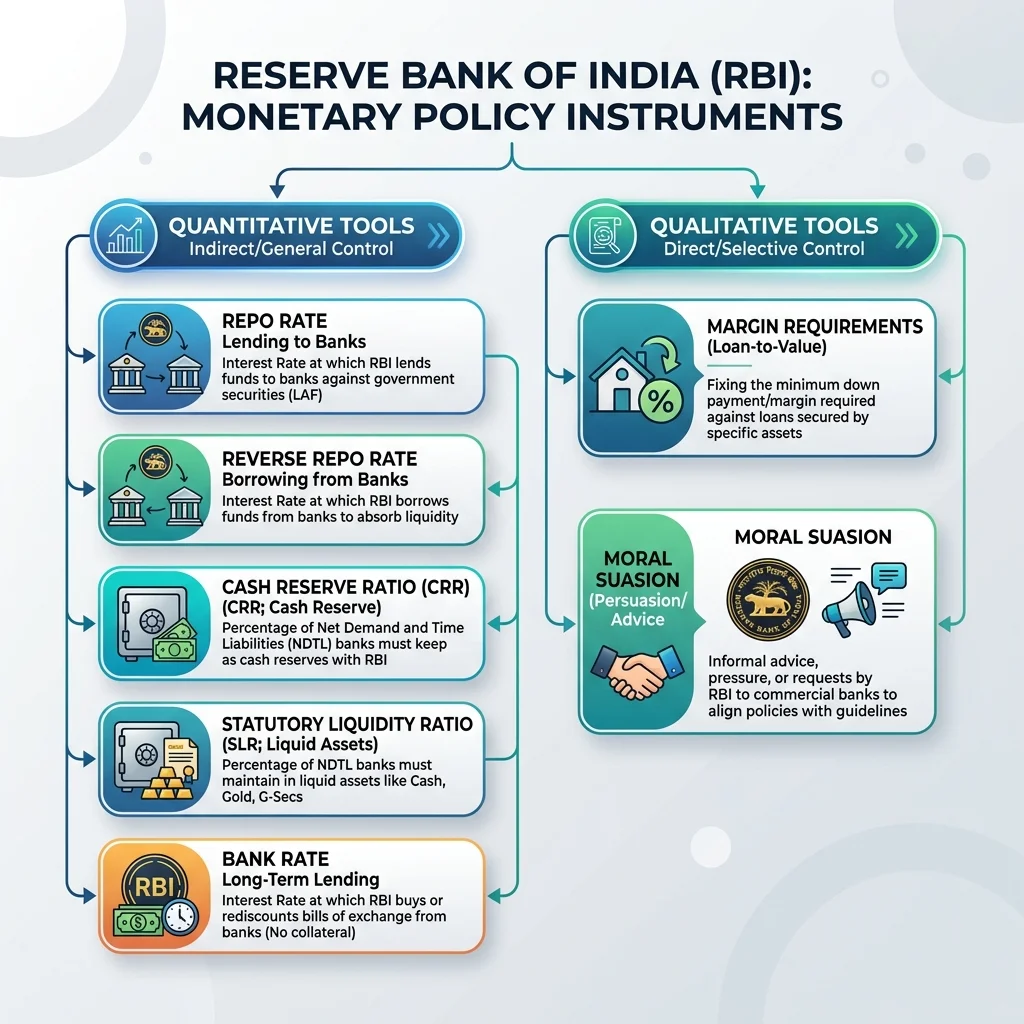
RBI Monetary Policy Instruments Flowchart
Visualizing the quantitative (volume-based) and qualitative (direction-based) credit control tools of the RBI.

Quantitative / General Tools

  • Cash Reserve Ratio (CRR): The share of Net Demand and Time Liabilities (NDTL) that commercial banks must keep as cash balance with the RBI. No interest is paid on CRR balances.
  • Statutory Liquidity Ratio (SLR): The share of NDTL that commercial banks must maintain with themselves in the form of liquid assets (cash, gold, or approved government securities).
  • Repo Rate: The rate at which the RBI lends money to commercial banks against government securities for short-term liquidity mismatches.
  • Reverse Repo Rate: The rate at which the RBI absorbs liquidity from commercial banks by borrowing from them against government securities. *Always lower than the Repo Rate.*
  • Marginal Standing Facility (MSF): An overnight borrowing window for banks to borrow from the RBI by dipping into their SLR securities up to a limit, at a penal rate (usually higher than the repo rate).
  • Bank Rate: The rate at which the RBI is prepared to buy or rediscount bills of exchange or other commercial papers. It is a long-term rate and does not require collateral.
  • Open Market Operations (OMO): The buying and selling of government securities by the RBI in the open market to regulate the money supply.

Qualitative / Selective Tools

  • Moral Suasion: Informal advice, persuasion, and pressure exerted by the RBI on banks to align with its monetary stance.
  • Margin Requirements: The difference between the loan value and the market value of the collateral security pledged. Raising the margin requirement reduces borrowing capacity.

4. Practice Questions (20 Premium Solved Questions)

Question 01CGL Pattern

On the recommendation of which of the following commissions was the Reserve Bank of India (RBI) established in 1935?

A) Hilton Young Commission
B) Chamberlain Commission
C) Fowler Commission
D) Babington Smith Commission
Correct answer: A) Hilton Young Commission

Step-by-step Solution

Step 1: Identify the historical commission associated with Indian currency and finance.
Step 2: The Royal Commission on Indian Currency and Finance, chaired by Edward Hilton Young, submitted its report in 1926.
Step 3: It recommended the creation of a central bank, leading to the enactment of the RBI Act in 1934 and its setup in 1935.
Conclusion: Option A is correct.
Question 02CGL Pattern

In which year was the Reserve Bank of India (RBI) nationalized, making it fully government-owned?

A) 1935
B) 1947
C) 1949
D) 1950
Correct answer: C) 1949

Step-by-step Solution

Step 1: The RBI was established as a private shareholder's bank with a share capital of Rs. 5 crore in 1935.
Step 2: Following independence, the government passed the Transfer to Public Ownership Act, nationalizing the RBI with effect from 1 January 1949.
Conclusion: Option C is correct.
Question 03CGL Pattern

Who was appointed as the first Indian Governor of the Reserve Bank of India (RBI) in 1943?

A) Sir Osborne Smith
B) Sir James Taylor
C) C.D. Deshmukh
D) Benegal Rama Rau
Correct answer: C) C.D. Deshmukh

Step-by-step Solution

Step 1: Sir Osborne Smith was the first Governor of the RBI (1935-1937), but he was British.
Step 2: Sir Chintaman Dwarkanath Deshmukh (C.D. Deshmukh) was appointed Governor in 1943 and was the first Indian to hold the post.
Conclusion: Option C is correct.
Question 04CGL Pattern

The Imperial Bank of India, which was created in 1921 by merging three presidency banks, was nationalized and renamed in 1955 as the:

A) Reserve Bank of India
B) State Bank of India
C) Punjab National Bank
D) Union Bank of India
Correct answer: B) State Bank of India

Step-by-step Solution

Step 1: The Imperial Bank of India was the largest commercial bank in pre-independence India.
Step 2: Based on the recommendations of the All India Rural Credit Survey Committee (Gorwala Committee), it was nationalized in July 1955 and renamed the State Bank of India (SBI).
Conclusion: Option B is correct.
Question 05CGL Pattern

How many major commercial banks were nationalized during the first phase of bank nationalization on July 19, 1969?

A) 6 banks
B) 10 banks
C) 14 banks
D) 20 banks
Correct answer: C) 14 banks

Step-by-step Solution

Step 1: The first major phase of bank nationalization targeted commercial banks with deposits of Rs. 50 crore or more.
Step 2: A total of 14 banks were nationalized on July 19, 1969 under PM Indira Gandhi.
Step 3: In the second phase in 1980, 6 more banks were nationalized.
Conclusion: Option C is correct.
Question 06CGL Pattern

What is the rate at which the Reserve Bank of India lends short-term money to commercial banks against government securities as collateral?

A) Bank Rate
B) Reverse Repo Rate
C) Repo Rate
D) MSF Rate
Correct answer: C) Repo Rate

Step-by-step Solution

Step 1: The rate at which the central bank lends short-term funds to banks with collateral is called the Repurchase Rate or Repo Rate.
Step 2: The Bank Rate is for long-term lending without collateral. MSF is for overnight lending.
Conclusion: Option C is correct.
Question 07CGL Pattern

What does the abbreviation CRR stand for in commercial banking and monetary policy?

A) Capital Reserve Ratio
B) Credit Reserve Ratio
C) Cash Reserve Ratio
D) Currency Reserve Ratio
Correct answer: C) Cash Reserve Ratio

Step-by-step Solution

Step 1: CRR stands for Cash Reserve Ratio, representing the cash reserves banks must hold with the RBI.
Conclusion: Option C is correct.
Question 08CGL Pattern

Under the Cash Reserve Ratio (CRR), commercial banks must maintain a specific percentage of their NDTL as deposits with:

A) Themselves in liquid assets
B) The Reserve Bank of India
C) The Ministry of Finance
D) The State Bank of India
Correct answer: B) The Reserve Bank of India

Step-by-step Solution

Step 1: CRR requires banks to keep cash balances outside their vaults.
Step 2: These cash balances must be deposited with the RBI, and banks earn no interest on these reserves.
Conclusion: Option B is correct.
Question 09CGL Pattern

Statutory Liquidity Ratio (SLR) requires commercial banks to maintain a certain percentage of their NDTL in liquid assets (gold, government securities, cash) with:

A) The Reserve Bank of India
B) Themselves
C) The State Bank of India
D) The public
Correct answer: B) Themselves

Step-by-step Solution

Step 1: Unlike CRR (which is kept with RBI), Statutory Liquidity Ratio (SLR) represents assets kept within the bank's own vaults.
Step 2: These assets are held in safe, highly liquid forms like government bonds, gold, or cash.
Conclusion: Option B is correct.
Question 10CGL Pattern

The rate at which the Reserve Bank of India is prepared to buy or rediscount bills of exchange or other commercial papers for long-term lending without collateral is:

A) Repo Rate
B) Reverse Repo Rate
C) Bank Rate
D) MSF Rate
Correct answer: C) Bank Rate

Step-by-step Solution

Step 1: Define long-term central bank lending without collateral.
Step 2: This rate is the Bank Rate (Article 49 of the RBI Act).
Conclusion: Option C is correct.
Question 11CGL Pattern

What is the buying and selling of government securities in the open market by the RBI to regulate money supply called?

A) Open Market Operations (OMO)
B) Liquidity Adjustment Facility (LAF)
C) Market Stabilization Scheme (MSS)
D) Moral Suasion
Correct answer: A) Open Market Operations (OMO)

Step-by-step Solution

Step 1: When RBI sells securities, it absorbs liquidity. When it buys, it injects liquidity.
Step 2: This market activity is defined as Open Market Operations (OMO).
Conclusion: Option A is correct.
Question 12CGL Pattern

The Marginal Standing Facility (MSF) rate was introduced by the RBI in 2011 to allow banks to borrow overnight funds by:

A) Pledging corporate bonds
B) Dipping into their SLR (Statutory Liquidity Ratio) quota
C) Depositing physical gold with RBI
D) Accessing the interbank call money market
Correct answer: B) Dipping into their SLR (Statutory Liquidity Ratio) quota

Step-by-step Solution

Step 1: Under normal repo, banks cannot use securities that are locked in their SLR quota.
Step 2: MSF is a special window where banks can borrow overnight funds by dipping into their SLR securities up to a specified percentage of NDTL, at a higher penal interest rate.
Conclusion: Option B is correct.
Question 13CGL Pattern

In commercial banking and RBI statistics, what does the abbreviation NDTL stand for?

A) National Debt and Tax Liabilities
B) Net Deposit and Time Liabilities
C) Net Demand and Time Liabilities
D) Nominal Demand and Total Liabilities
Correct answer: C) Net Demand and Time Liabilities

Step-by-step Solution

Step 1: NDTL represents the total demand deposits (current/savings accounts) and time deposits (fixed/recurring deposits) held by a bank, minus interbank deposits.
Step 2: It is the base on which reserve requirements (CRR, SLR) are calculated.
Conclusion: Option C is correct.
Question 14CGL Pattern

Which of the following is categorized as a Qualitative (selective) tool of monetary policy in India?

A) Cash Reserve Ratio (CRR)
B) Repo Rate
C) Margin Requirements
D) Open Market Operations (OMO)
Correct answer: C) Margin Requirements

Step-by-step Solution

Step 1: Quantitative tools (CRR, Repo, OMO) affect the total volume of money in the system.
Step 2: Qualitative tools affect the direction and flow of credit to specific sectors.
Step 3: Margin requirements (collateral hair-cuts) and moral suasion are qualitative tools.
Conclusion: Option C is correct.
Question 15CGL Pattern

If the Reserve Bank of India wants to curb high inflation in the economy, what action is it most likely to take?

A) Decrease the Repo Rate
B) Increase the Repo Rate
C) Buy government securities in the open market
D) Lower the SLR
Correct answer: B) Increase the Repo Rate

Step-by-step Solution

Step 1: To control inflation, the RBI must reduce the money supply and discourage borrowing.
Step 2: By increasing the Repo Rate, borrowing becomes costlier for commercial banks, which pass on the higher rates to consumers.
Step 3: This dampens demand and checks price rises. Lowering reserve requirements or buying securities would inject money, worsening inflation.
Conclusion: Option B is correct.
Question 16CGL Pattern

Who was the first Governor of the Reserve Bank of India upon its establishment in 1935?

A) Sir Osborne Smith
B) Sir James Taylor
C) C.D. Deshmukh
D) L.K. Jha
Correct answer: A) Sir Osborne Smith

Step-by-step Solution

Step 1: The RBI commenced operations on April 1, 1935.
Step 2: Sir Osborne Smith, an Australian banker, was appointed its first Governor, serving until 1937.
Conclusion: Option A is correct.
Question 17CGL Pattern

In which year did the second phase of bank nationalization take place in India, nationalizing 6 commercial banks?

A) 1969
B) 1975
C) 1980
D) 1985
Correct answer: C) 1980

Step-by-step Solution

Step 1: The first phase nationalized 14 banks in 1969.
Step 2: The second phase nationalized 6 banks with deposits over Rs 200 crore on April 15, 1980.
Conclusion: Option C is correct.
Question 18CGL Pattern

Where was the central headquarters of the Reserve Bank of India originally located before moving permanently to Bombay in 1937?

A) Delhi
B) Madras
C) Calcutta (Kolkata)
D) Allahabad
Correct answer: C) Calcutta (Kolkata)

Step-by-step Solution

Step 1: The RBI was established in Calcutta in 1935 as its central office.
Step 2: The central office was permanently moved to Bombay (now Mumbai) in 1937.
Conclusion: Option C is correct.
Question 19CGL Pattern

The statutory framework for the RBI's inflation-targeting mandate is currently set at what percentage?

A) 3% CPI with a band of +/- 1%
B) 4% CPI with a band of +/- 2%
C) 5% WPI with a band of +/- 2%
D) 6% CPI with a band of +/- 1%
Correct answer: B) 4% CPI with a band of +/- 2%

Step-by-step Solution

Step 1: Under the amended RBI Act, the inflation target is set at 4% Consumer Price Index (CPI).
Step 2: The tolerance band is 2% to 6% (4% +/- 2%).
Conclusion: Option B is correct.
Question 20CGL Pattern

Who serves as the chairperson of the 6-member Monetary Policy Committee (MPC) of India?

A) Prime Minister of India
B) Union Finance Minister
C) Governor of the Reserve Bank of India
D) Chief Economic Adviser
Correct answer: C) Governor of the Reserve Bank of India

Step-by-step Solution

Step 1: The MPC is constituted under Section 45ZB of the amended RBI Act, 1934.
Step 2: It consists of 6 members (3 from RBI, 3 nominated by Gov).
Step 3: The Governor of the RBI is the ex-officio Chairperson of the MPC.
Conclusion: Option C is correct.

Strategy errors to avoid

!

CRR vs. SLR Locations

Never confuse where reserves are kept. CRR must be deposited with the RBI in cash. SLR is maintained by commercial banks with themselves in liquid assets. This operational distinction is a favorite CGL question.

!

Repo vs. Bank Rate

Repo rate is short-term lending against government security collateral. Bank rate is long-term rediscounting without collateral. Always verify the loan term in the question text before answering.