Master Physical Geography (Solar System, Earth, Atmosphere) for SSC CGL
Get comprehensive theory, expert shortcuts, and hand-picked practice questions for Physical Geography (Solar System, Earth, Atmosphere) specifically designed for the SSC CGL 2025-26 pattern.
Physical Geography: Solar System, Earth's Structure & Atmosphere
Physical Geography is a cornerstone of the General Awareness section in the SSC CGL examination. It covers the fundamental dynamics of our planet, including the composition of the Solar System, the Earth's interior layering, atmospheric stratification, global wind circulation, and key geomorphological processes. This guide outlines high-yield concepts and facts tailored to the latest CGL patterns.
Learning path
- Solar System & Planetary Dynamics
- Earth's Interior & Discontinuities
- Atmosphere, Pressure Belts & Local Winds
- 20 Premium Practice Questions
1. The Solar System & Earth Movements
The Solar System consists of the Sun and the celestial bodies bound to it by gravity. Understanding the classifications and distinct features of planets is essential:
- Inner Planets (Terrestrial / Rocky): Mercury, Venus, Earth, and Mars. They have dense, rocky compositions and few or no moons.
- Outer Planets (Jovian / Gas Giants): Jupiter, Saturn, Uranus, and Neptune. They are composed mostly of gases and ice, possess extensive ring systems, and have many moons.
- Venus: The hottest planet (due to a runaway greenhouse effect from dense CO₂ atmosphere). It is also the brightest planet, known as the "Morning Star", "Evening Star", and "Earth's Twin" (due to similar size and mass). It rotates clockwise (retrograde rotation).
- Mars: Known as the "Red Planet" due to the presence of iron oxide on its surface. It has two natural satellites: Phobos and Deimos.
- Jupiter & Saturn: Jupiter is the largest planet and has the shortest day (fastest rotation). Its moon Ganymede is the largest satellite in the solar system. Saturn is known for its spectacular ring system and its largest moon Titan, which has a dense atmosphere.
Earth's Rotation and Revolution
The Earth exhibits two primary motions that dictate seasonal and diurnal patterns:
- Rotation: The Earth spins on its axis from West to East once every 24 hours. This causes day and night and generates the Coriolis Effect (deflection of winds).
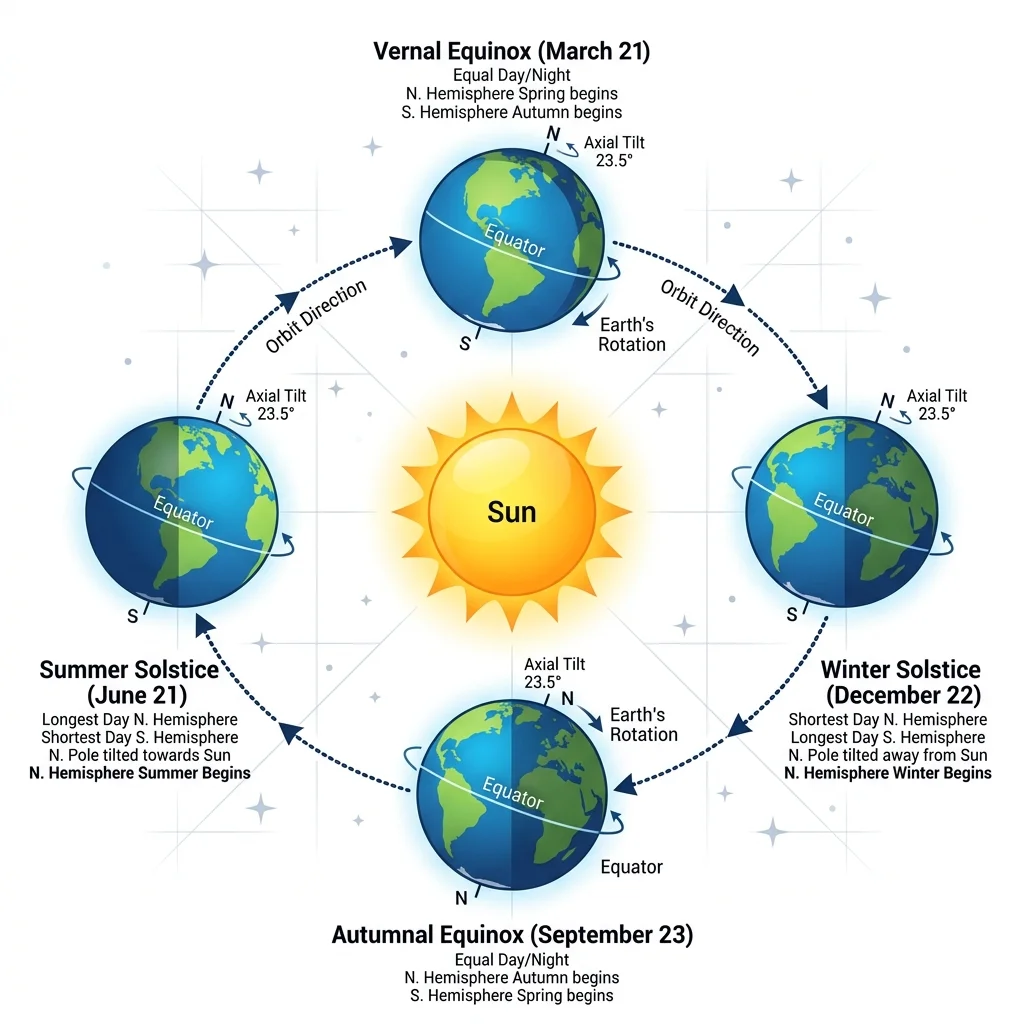
- Revolution: The Earth orbits the Sun in an elliptical path once every 365.25 days. Combined with the axial tilt of 23.5°, revolution causes seasons and changing lengths of day and night.
- Solstice:
- Summer Solstice (June 21): The Northern Hemisphere is tilted towards the Sun, resulting in the longest day of the year in the north.
- Winter Solstice (December 22): The Southern Hemisphere is tilted towards the Sun, making it the shortest day in the Northern Hemisphere.
- Equinox: The Sun shines directly over the Equator, resulting in equal day and night lengths globally. Occurs on March 21 (Vernal/Spring Equinox) and September 23 (Autumnal Equinox).
- Orbital Extremes: Perihelion is when Earth is closest to the Sun (approx. Jan 3), and Aphelion is when Earth is farthest from the Sun (approx. July 4).
2. Internal Structure of the Earth
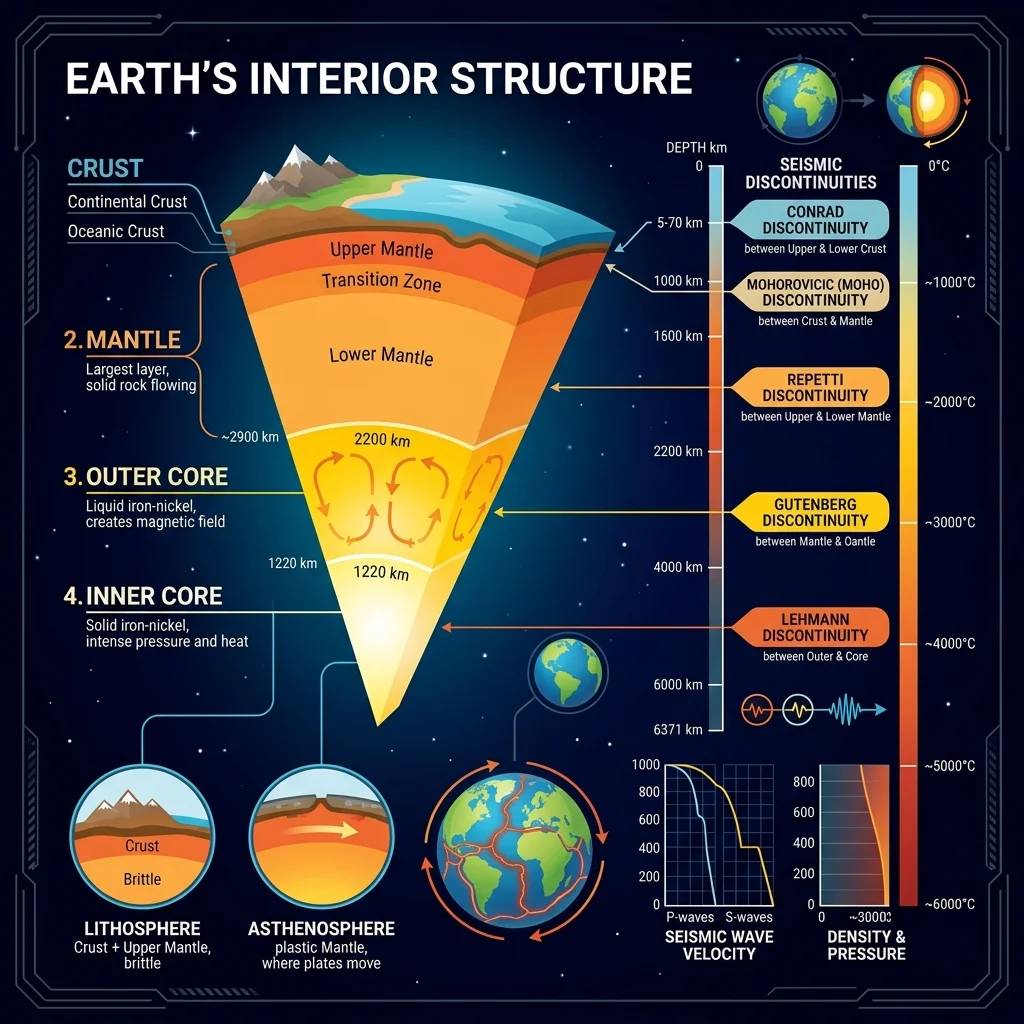
The Earth's interior is chemically and mechanically stratified. The chemical layers consist of:
- Crust: The outermost solid layer, subdivided into the continental crust (composed of SIAL - Silica & Aluminium) and the oceanic crust (composed of SIMA - Silica & Magnesium).
- Mantle: Extends down to 2,900 km, representing about 84% of the Earth's volume. Its upper section contains the Asthenosphere, which is semi-fluid (plastic) and the primary source of volcanic magma.
- Core: The innermost layer, composed mainly of Nickel and Iron (NIFE). The outer core is liquid (responsible for Earth's magnetic field), and the inner core is solid due to extreme pressure.
Seismic Discontinuities
Boundary zones separating distinct layers are marked by rapid changes in seismic wave velocities. Candidates must memorize these transitions:
| Discontinuity Name | Separates Layer A | From Layer B |
|---|---|---|
| Conrad | Upper Crust | Lower Crust |
| Mohorovicic (Moho) | Crust | Mantle |
| Repetti | Upper Mantle | Lower Mantle |
| Gutenberg | Mantle | Outer Core |
| Lehmann | Outer Core | Inner Core |
Rocks Classification
Rocks are classified into three major groups based on their mode of origin:
- Igneous Rocks: Formed by the cooling and solidification of molten rock (magma/lava). Examples: Granite, Basalt, Gabbro, and Pumice. Basil/Basalt is a major constituent of the oceanic crust.
- Sedimentary Rocks: Formed by the deposition, compaction, and cementation of mineral and organic particles over time. They often contain fossils. Examples: Sandstone, Limestone, Shale, Conglomerate, and Coal.
- Metamorphic Rocks: Formed when existing rocks undergo mineralogical and structural changes due to intense heat and pressure (without melting). Examples: Marble (from Limestone), Quartzite (from Sandstone), Slate (from Shale), and Gneiss (from Granite).
3. Atmosphere, Pressure Belts & Local Winds
The Earth's atmosphere is a protective envelope of gases. It consists primarily of Nitrogen (78%), Oxygen (21%), Argon (0.93%), and Carbon Dioxide (0.04%).
Atmospheric Layers
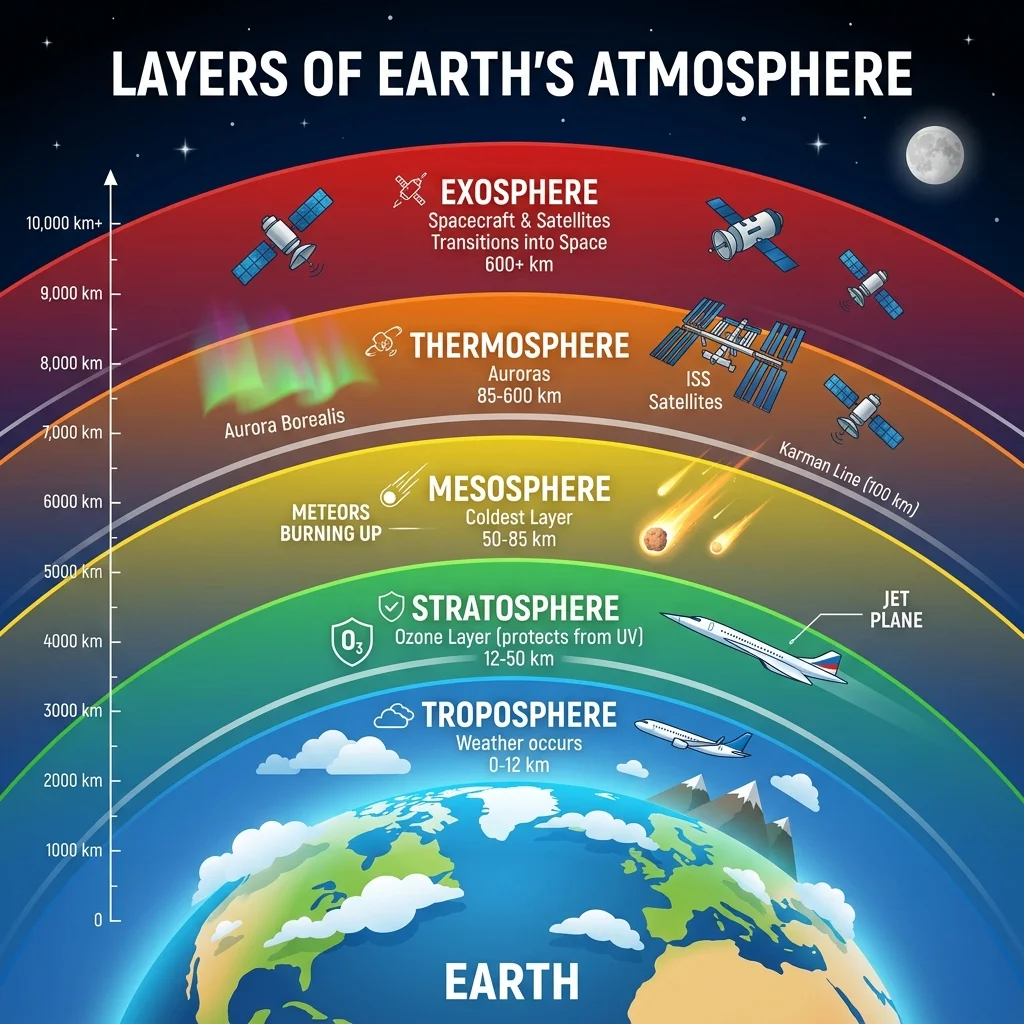
The atmosphere is divided vertically into five layers based on temperature variations:
- Troposphere: The lowest layer where all weather phenomena (clouds, rain, storms) occur. It contains 75% of the atmosphere's mass. Temperature decreases with altitude at the rate of approximately 6.5°C per km (Normal Lapse Rate).
- Stratosphere: Extends up to 50 km. It is free from weather disturbances and clouds, making it ideal for flying commercial jet aircraft. It contains the Ozone Layer (Ozonosphere), which absorbs harmful solar Ultraviolet (UV) radiation. Temperature increases with height here.
- Mesosphere: Extends up to 80 km. It is the coldest layer of the atmosphere (temperatures drop to -100°C). Meteors burn up in this layer upon entering from space.
- Thermosphere (includes Ionosphere): Extends from 80 to 400 km. It contains electrically charged ions that reflect radio signals back to Earth, enabling wireless communication. Temperature rises rapidly with height.
- Exosphere: The uppermost layer, which gradually merges with outer space. It is composed of extremely low-density light gases like Hydrogen and Helium.
Global Pressure Belts & Winds
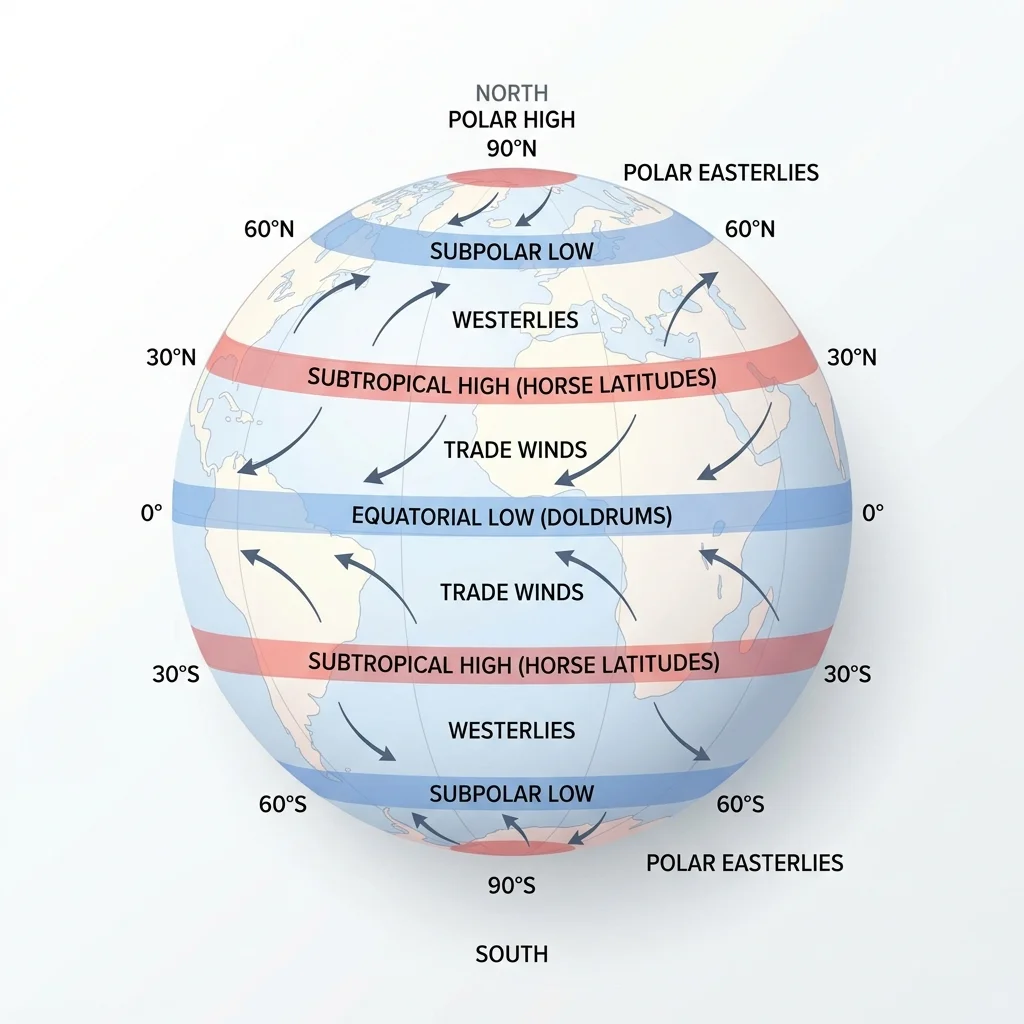
Differential solar heating sets up permanent high and low-pressure belts across the globe:
- Equatorial Low (Doldrums): Located between 5°N and 5°S. Characterized by intense heating, rising air, and calm winds.
- Subtropical Highs (Horse Latitudes): Located around 30°N and 30°S. Characterized by descending dry air, clear skies, and calm conditions.
- Planetary Wind Systems:
- Trade Winds: Blow from the Subtropical Highs towards the Equatorial Low.
- Westerlies: Blow from the Subtropical Highs towards the Subpolar Lows.
- Polar Easterlies: Blow from the Polar Highs towards the Subpolar Lows.
Important Local Winds
Local winds are periodic or seasonal winds generated by localized temperature and pressure differences. These are frequently tested in CGL:
Chinook (Rockies, USA/Canada)
A warm, dry wind blowing down the eastern slopes of the Rocky Mountains. Known as the "Snow Eater" because it melts winter snow cover quickly.
Loo (Northern India / Pakistan)
A hot, dry, and dusty summer wind that blows across the Indo-Gangetic plains during May and June, causing heatwaves.
Harmattan (West Africa)
A dry, dusty wind blowing from the Sahara desert towards the Gulf of Guinea. Known as "The Doctor" due to its dry and relative health-promoting qualities compared to damp tropical air.
Sirocco (Sahara to Mediterranean)
A warm, dry, and dusty wind originating in the Sahara and blowing north across the Mediterranean Sea to Southern Europe, often bringing "blood rain" (red dust).
4. Practice Questions (20 Premium Solved Questions)
Which planetary satellite in the Solar System is the largest in size, even larger than the planet Mercury?
Step-by-step Solution
The Mohorovicic discontinuity (Moho) forms the boundary between which two layers of the Earth?
Step-by-step Solution
Which layer of the atmosphere contains the Ozone Layer that absorbs harmful solar ultraviolet rays?
Step-by-step Solution
On which date does the Summer Solstice occur in the Northern Hemisphere, resulting in the longest day of the year?
Step-by-step Solution
Which local wind is warm, dry, blows down the eastern slopes of the Rocky Mountains, and is famously known as the 'Snow Eater'?
Step-by-step Solution
Which type of rock is formed by the alteration of pre-existing rocks under the influence of high temperature and pressure without melting?
Step-by-step Solution
The semi-fluid, ductile layer in the upper mantle on which tectonic plates float is known as the:
Step-by-step Solution
Which of the following gases is the third most abundant gas by volume in the Earth's atmosphere?
Step-by-step Solution
What is the name of the planetary wind system that blows from the Subtropical High Pressure belts to the Equatorial Low Pressure belt?
Step-by-step Solution
The point on the Earth's surface directly above the focus (hypocentre) of an earthquake is known as the:
Step-by-step Solution
Which planet is known as the 'Morning Star' and 'Evening Star', and rotates clockwise (from East to West) on its axis?
Step-by-step Solution
Marble is a metamorphic rock that originates from the metamorphism of which sedimentary rock?
Step-by-step Solution
Which atmospheric layer is the coldest, with temperatures dropping as low as -100°C, and is the layer where meteors burn up?
Step-by-step Solution
The Gutenberg discontinuity forms the boundary separating which two major divisions of the Earth?
Step-by-step Solution
The Coriolis Effect, which deflects winds to the right in the Northern Hemisphere and to the left in the Southern Hemisphere, is caused by the Earth's:
Step-by-step Solution
Which local wind blowing from the Sahara desert towards West Africa is known as 'The Doctor' because of its dry and cooling nature?
Step-by-step Solution
Which seismic wave can travel through both solid and liquid mediums, and is longitudinal in nature?
Step-by-step Solution
The term 'Sial' representing the continental crust is chemically composed of which two primary elements?
Step-by-step Solution
The phenomenon of 'Aphelion' refers to the position of the Earth when it is:
Step-by-step Solution
Which of the following is a classic example of an extrusive igneous rock, formed by rapid cooling of lava on the surface, which is rich in basaltic minerals?
Step-by-step Solution
Strategy errors to avoid
Conflating Discontinuities
Do not mix up Mohorovicic (Moho) and Gutenberg discontinuities. Moho separates the outer crust from the mantle, whereas Gutenberg divides the mantle from the deep core. Remembering them in order from outer to inner is crucial.
Wind Directions & Characteristics
Always associate Chinook with the USA/Canada Rocky Mountains and Harmattan with West Africa. CGL questions often pair these local winds with incorrect geographic regions to trip up candidates.