Master Indian Constitution (Preamble, Articles, Schedules) for SSC CGL
Get comprehensive theory, expert shortcuts, and hand-picked practice questions for Indian Constitution (Preamble, Articles, Schedules) specifically designed for the SSC CGL 2025-26 pattern.
Indian Constitution: Making, Sources, Preamble & Schedules
The Indian Constitution is the supreme law of India, forming the bedrock of all administrative and legal processes. For SSC CGL, candidates must master the historical timeline of the Constituent Assembly, the specific constitutional features borrowed from other nations, the core vocabulary of the Preamble, and the twelve Schedules. This guide outlines the key theory and facts alongside 20 solved exam-pattern questions.
Learning path
- Making of the Constitution & Key Dates
- Borrowed Sources of the Constitution
- The Preamble & Twelve Schedules
- 20 CGL-Pattern Practice Questions
1. The Constituent Assembly & Making process
The idea of a Constituent Assembly for India was first proposed by M.N. Roy in 1934. It was officially demanded by the Indian National Congress in 1935 and accepted in principle by the British government through the August Offer of 1940. The assembly was finally constituted in November 1946 under the scheme formulated by the Cabinet Mission Plan.
- First Meeting: December 9, 1946. Dr. Sachchidananda Sinha was elected as the temporary/interim President of the Assembly, following French practice (senior-most member).
- Permanent President: On December 11, 1946, Dr. Rajendra Prasad was elected as President, and H.C. Mukherjee was elected as Vice-President. Sir B.N. Rau was appointed as the Constitutional Advisor to the Assembly.
- Objective Resolution: Moved by Jawaharlal Nehru on December 13, 1946, which later became the Preamble of the Constitution. It was unanimously adopted on January 22, 1947.
- Time Taken: The Assembly took 2 years, 11 months, and 18 days to draft the Constitution, holding 11 sessions.
- Drafting Committee: Appointed on August 29, 1947, consisting of 7 members, with Dr. B.R. Ambedkar as the Chairman (celebrated as the Father of the Indian Constitution).
- Adoption & Enforcement: The Constitution was adopted on November 26, 1949 (observed as Constitution Day / Samvidhan Divas). It originally contained 395 Articles, 22 Parts, and 8 Schedules. It came into force on January 26, 1950 (celebrated as Republic Day), which was selected because on that day in 1930, the Purna Swaraj declaration was made.
2. Borrowed Sources of the Constitution
The Indian Constitution has drawn its features from various global constitutions as well as the Government of India Act of 1935. Dr. B.R. Ambedkar proudly stated that it was framed after "ransacking all the known Constitutions of the world":
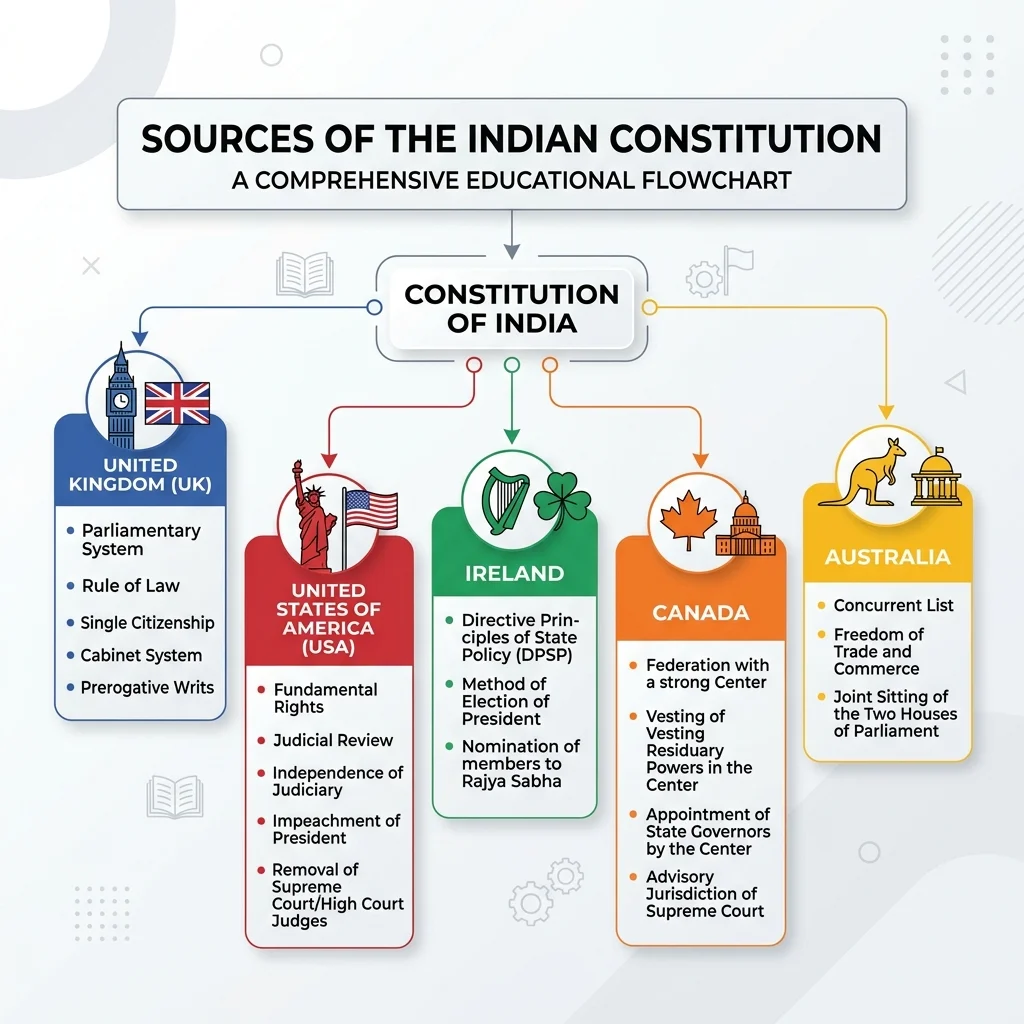
- Government of India Act 1935: Federal scheme, office of Governor, Judiciary, Public Service Commissions, Emergency provisions, and administrative details.
- British Constitution (UK): Parliamentary form of government, Rule of Law, legislative procedure, Single Citizenship, cabinet system, legislative writs, bicameralism.
- United States Constitution (US): Fundamental Rights, independence of judiciary, Judicial Review, impeachment of the President, removal of Supreme Court and High Court judges, office of Vice-President.
- Irish Constitution: Directive Principles of State Policy (DPSP), nomination of members to Rajya Sabha, method of election of the President.
- Canadian Constitution: Federation with a strong Centre, vesting of residuary powers in the Centre, appointment of state governors by the Centre, advisory jurisdiction of the Supreme Court.
- Australian Constitution: Concurrent List, freedom of trade, commerce and intercourse, joint sitting of the two Houses of Parliament.
- Weimar Constitution of Germany: Suspension of Fundamental Rights during Emergency.
- Soviet Constitution (USSR / Russia): Fundamental Duties, ideal of justice (social, economic, and political) in the Preamble.
- French Constitution: Republic, ideals of liberty, equality, and fraternity in the Preamble.
- South African Constitution: Procedure for amendment of the Constitution, election of members of Rajya Sabha.
3. The Preamble & Twelve Schedules
The Preamble
The Preamble serves as an introductory statement outlining the goals and values of the Constitution. It declares India to be a Sovereign, Socialist, Secular, Democratic, Republic.
The Preamble has been amended only once, by the 42nd Constitutional Amendment Act of 1976, which added three new words: Socialist, Secular, and Integrity.
The 12 Schedules
Schedules are additional lists that categorize administrative details. Candidates can use the popular mnemonic "TEARS OF OLD PM" to memorize the 12 schedules in order:
- T - Territories: Names of States and Union Territories with their territorial jurisdictions.
- E - Emoluments: Provisions relating to salaries, allowances, and privileges of President, Governors, Speaker, Judges, etc.
- A - Affirmations/Oaths: Oaths and affirmations for Union ministers, MPs, Judges, CAG.
- R - Rajya Sabha: Allocation of seats in the Rajya Sabha (Council of States) to States and Union Territories.
- S - Scheduled Areas: Administration and control of scheduled areas and scheduled tribes.
- O - Other Areas: Administration of tribal areas in the northeastern states: Assam, Meghalaya, Tripura, and Mizoram (Mnemonic: ATM without Money - Assam, Tripura, Meghalaya, Mizoram).
- F - Federal List: Distribution of legislative powers (Union List, State List, Concurrent List).
- O - Official Languages: 22 recognized official languages (originally 14). Sindhi was added by the 21st Amendment, Konkani, Manipuri, and Nepali by the 71st, and Bodo, Dogri, Maithili, and Santhali by the 92nd.
- L - Land Reforms: Acts and regulations relating to land reforms (Added by the 1st Amendment of 1951 to shield laws from judicial review).
- D - Defection: Provisions relating to disqualification of members on ground of defection (Added by the 52nd Amendment of 1985).
- P - Panchayats: Powers, authority, and responsibilities of Panchayats (Contains 29 matters; added by the 73rd Amendment of 1992).
- M - Municipalities: Powers, authority, and responsibilities of Municipalities (Contains 18 matters; added by the 74th Amendment of 1992).
4. Practice Questions (20 Premium Solved Questions)
On which date did the Constituent Assembly of India formally adopt the Constitution of India?
Step-by-step Solution
Who among the following was elected as the temporary (interim) President of the Constituent Assembly during its first meeting on December 9, 1946?
Step-by-step Solution
The structural model of the Preamble in the Indian Constitution, as well as the concept of 'We, the People', was inspired by the constitution of which country?
Step-by-step Solution
By which Constitutional Amendment Act of 1976 were the three terms 'Socialist', 'Secular', and 'Integrity' inserted into the Preamble?
Step-by-step Solution
The feature of 'Directive Principles of State Policy' (DPSP) contained in Part IV of the Indian Constitution was borrowed from which country's constitution?
Step-by-step Solution
Which schedule of the Indian Constitution lists the 22 languages recognized officially by the State?
Step-by-step Solution
The Tenth Schedule of the Indian Constitution, which contains provisions for disqualification of members on grounds of defection, was added by which amendment?
Step-by-step Solution
The power of Judicial Review and the independence of the Judiciary in India are borrowed from the constitutional framework of:
Step-by-step Solution
Who among the following was the Chairman of the Drafting Committee of the Constituent Assembly?
Step-by-step Solution
The Concurrent List (which contains subjects on which both Centre and States can legislate) was borrowed from which country?
Step-by-step Solution
Which schedule of the Constitution deals with the allocation of seats to the various States and Union Territories in the Rajya Sabha?
Step-by-step Solution
The concept of 'Procedure Established by Law' in Article 21 of the Indian Constitution is borrowed from which country?
Step-by-step Solution
Which Part of the Indian Constitution is described by historians as the 'Magna Carta of India'?
Step-by-step Solution
How many schedules were originally present in the Constitution of India when it was adopted in 1949?
Step-by-step Solution
The power to amend the Constitution and the procedure for it (Article 368) was adapted from the constitution of:
Step-by-step Solution
Oaths and Affirmations of Union Ministers, MPs, and Judges of Supreme Court are listed under which schedule?
Step-by-step Solution
Which schedule of the Indian Constitution contains provisions for the administration of tribal areas in Assam, Meghalaya, Tripura, and Mizoram?
Step-by-step Solution
The concept of 'Single Citizenship' in India, which means there is no separate state citizenship, is borrowed from:
Step-by-step Solution
Which constitutional amendment added the Eleventh Schedule, assigning 29 functional items to Panchayati Raj Institutions?
Step-by-step Solution
The vesting of 'Residuary Powers' (subjects not mentioned in Union, State, or Concurrent lists) in the Central Government was adapted from the constitution of:
Step-by-step Solution
Strategy errors to avoid
Adoption vs. Enforcement Dates
Never confuse November 26, 1949 (date of adoption/signing by the Constituent Assembly) with January 26, 1950 (date of enforcement). CGL questions routinely target this semantic difference.
Anti-defection Schedule Number
Always associate the Tenth Schedule with the 52nd Amendment of 1985. Mixing this up with the Ninth (Land reforms, 1st Amendment) or Eleventh (Panchayats, 73rd Amendment) is a very common source of negative marks.